NASA's most powerful space telescopes have uncovered a surprising acceleration in cosmic construction, showing that massive star clusters emerge from their natal gas clouds far more rapidly than previously understood—fundamentally challenging models of stellar evolution.
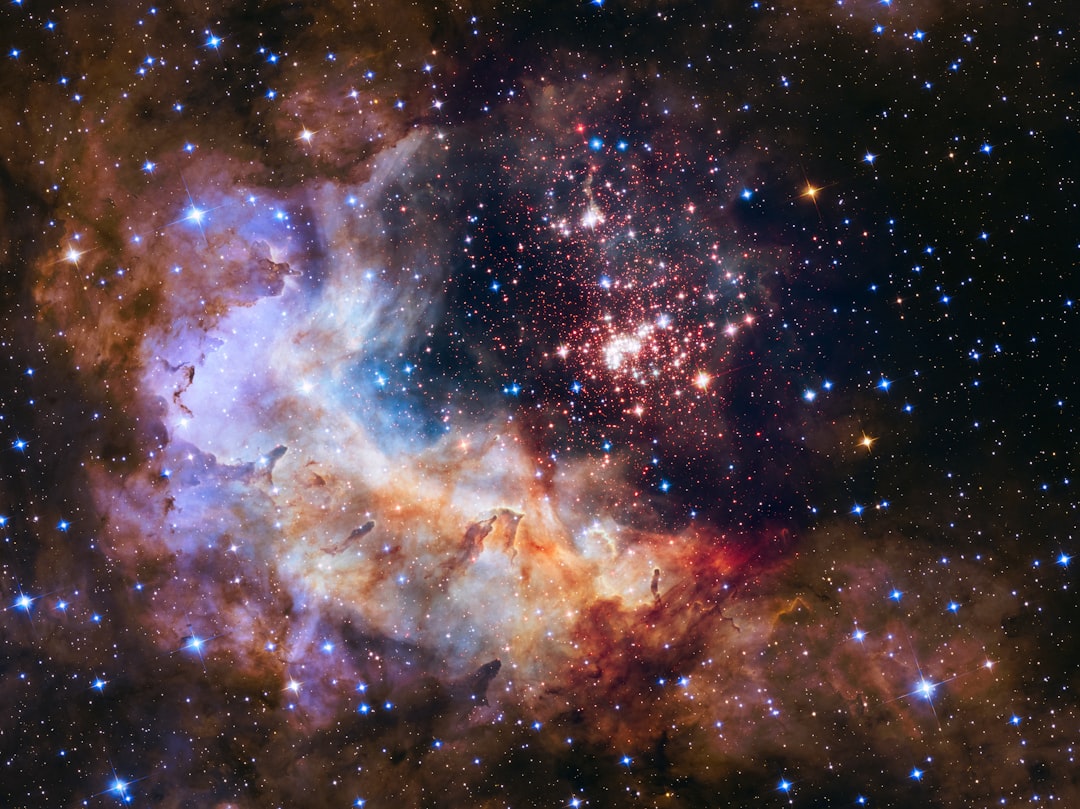
The research published by ESA analyzed nearly 9,000 star clusters across four nearby galaxies, revealing that massive clusters complete their formation in approximately 5 million years—significantly faster than the 7-8 million years required for smaller clusters. The finding emerged from the FEAST observing program, which combined James Webb Space Telescope's infrared observations with Hubble Space Telescope's optical data.
In space exploration, as across technological frontiers, engineering constraints meet human ambition—and occasionally, we achieve the impossible. The coordinated observations from both telescopes enabled scientists to peer through dense gas clouds while simultaneously observing fully dispersed clusters, creating an unprecedented timeline of stellar birth.
"Simulations of star formation and stellar feedback have struggled to reproduce how star clusters form and emerge from their natal clouds," said Angela Adamo from Stockholm University. "These results give us important new constraints on that process."
The accelerated timeline carries profound implications for planetary formation. Faster gas dispersal in massive clusters means that intense ultraviolet radiation from young, hot stars floods the surrounding region earlier than expected, potentially limiting the growth of protoplanetary disks and reducing opportunities for planet formation around those stars.
The research examined clusters at different evolutionary stages across galaxies including Messier 51, Messier 83, NGC 4449, and NGC 628—each offering unique perspectives on star cluster development. Webb's infrared capabilities proved essential for penetrating the thick dust and gas shrouding newborn clusters, while Hubble provided clarity on mature, fully emerged clusters.
Alex Pedrini, also from Stockholm University, emphasized the broader significance: "Using Webb, we can look into the cradles of star clusters and connect planet formation to the cycle of star formation and stellar feedback."
The findings challenge existing computational models of galactic evolution. Current simulations have struggled to accurately reproduce the observed formation timelines, and this new data provides critical constraints for improving those models. The research suggests that massive star clusters drive stellar feedback across galaxies more rapidly than previously modeled, potentially reshaping our understanding of how galaxies evolve over cosmic time.
The discovery demonstrates the power of multi-wavelength astronomy, where observations across different parts of the electromagnetic spectrum reveal phenomena invisible to any single instrument. As Webb continues its mission alongside Hubble, astronomers anticipate more revelations about the fundamental processes governing cosmic structure formation—from individual stars to entire galaxies.