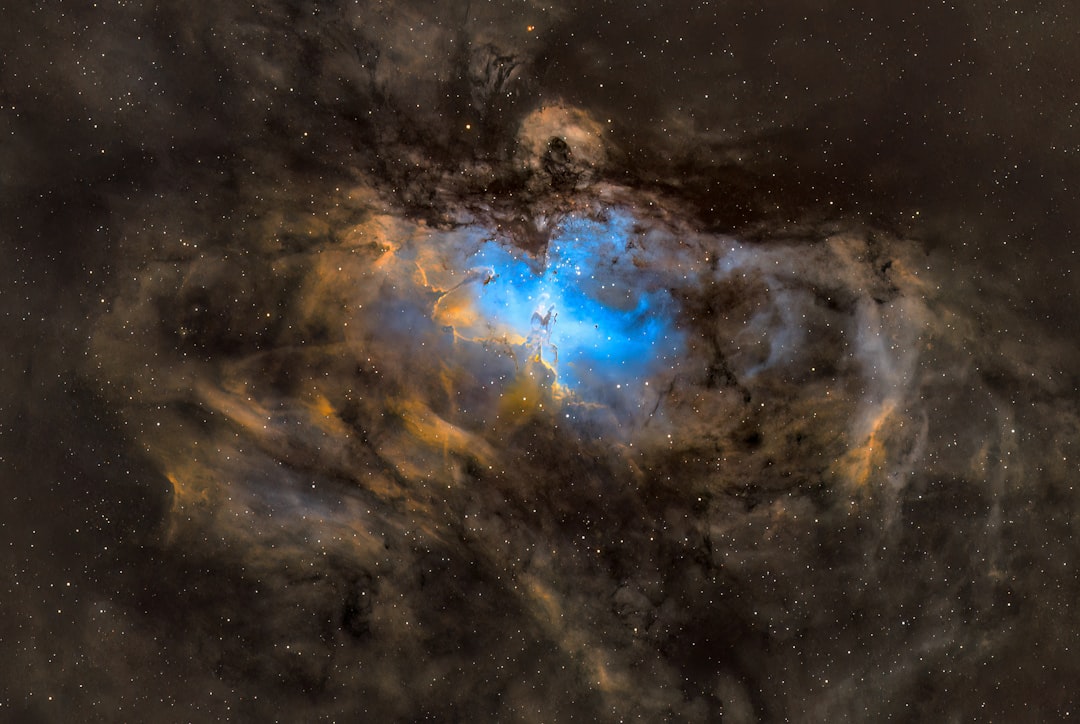
The James Webb Space Telescope has peered into a dying star's spectacular death throes, capturing the birthplace of enigmatic carbon structures called "buckyballs"—and revealing formations that leave astronomers genuinely puzzled about what they're witnessing.
The infrared imagery, released this week, shows the nebula Tc1 located 10,000 light-years away in the constellation Ara—Latin for "altar"—in the southern celestial hemisphere. The gas cloud surrounds a dying star shedding its outer layers, creating conditions where complex carbon molecules spontaneously form.
"The structures we're seeing now are breathtaking," said researchers analyzing the Webb observations. Among the nebula's features: an upside-down question mark shape that scientists cannot yet explain—a cosmic mystery embedded within Webb's exquisite imagery.
Buckyballs—formally called buckminsterfullerenes or C60 molecules—resemble miniature soccer balls, with 60 carbon atoms arranged in hexagons and pentagons forming a hollow sphere. These exotic structures, named after architect Buckminster Fuller's geodesic domes, represent one of nature's most elegant molecular geometries.
In space exploration, as across technological frontiers, engineering constraints meet human ambition—and occasionally, we achieve the impossible. Webb's infrared capabilities reveal molecular formation processes completely invisible to optical telescopes, opening windows into stellar chemistry that previous observatories could only infer indirectly.
The discovery raises fundamental questions about where and how these complex carbon molecules form. While scientists have detected buckyballs in space before, directly observing their birthplace provides crucial data about the conditions enabling their assembly. The nebular environment—rich in carbon ejected from the dying star's core—apparently provides ideal chemistry for buckyball synthesis.
These carbon structures hold significance beyond astronomical curiosity. Buckyballs can trap other atoms inside their hollow centers, potentially serving as microscopic containers for stellar material. Understanding their formation could illuminate how complex organic molecules—precursors to life—arise in cosmic environments.