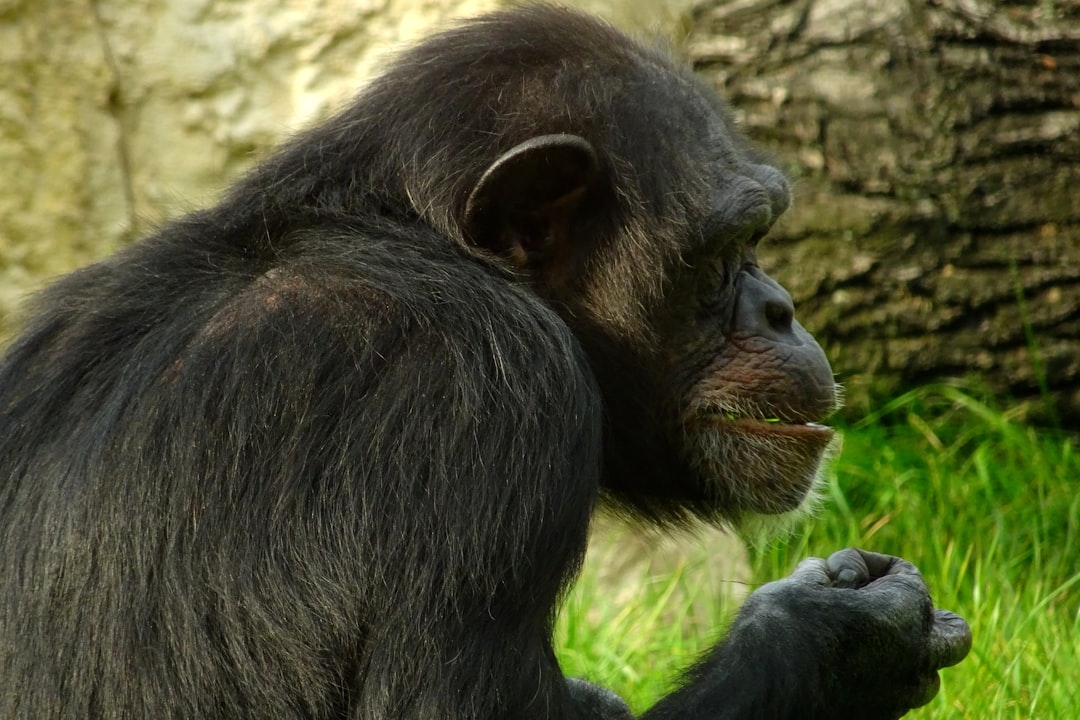
Researchers observing bonobos in captivity witnessed something remarkable: the great apes spontaneously organizing pretend tea parties, complete with imaginary cups, saucers, and elaborate social etiquette. The behavior, documented in new research, adds to mounting evidence that our closest evolutionary relatives possess cognitive abilities—imagination, abstract thinking, and social rituals—once thought uniquely human.
The tea party observations emerged from a comprehensive study published this week examining social behaviors in both bonobos and chimpanzees. Scientists recorded bonobos engaging in elaborate pretend scenarios, mimicking human behaviors they'd observed, including food preparation rituals, social gatherings, and cooperative care activities—all without tangible objects or immediate rewards.
"What's striking is the spontaneity and complexity of these behaviors," explained lead researcher Dr. Catherine Hobaiter, a primatologist at the University of St Andrews. "The bonobos weren't trained to do this. They independently developed pretend play scenarios that mirror human social rituals with remarkable fidelity."
The research extends beyond bonobos' playful antics. Parallel observations of chimpanzees revealed sophisticated rational thinking—the ability to weigh evidence, update beliefs based on new information, and make decisions using logical frameworks previously demonstrated only in humans and a handful of other species.
In controlled experiments, chimpanzees consistently demonstrated what researchers call "Bayesian reasoning"—updating probability estimates based on observed evidence. When presented with hidden food locations and partial clues, chimps modified their search strategies in ways that mirror human logical processes, suggesting they possess mental models of cause and effect.
These findings challenge traditional boundaries between human and animal cognition. For decades, scientists drew sharp lines separating our species from great apes: humans possess language, imagination, rational thought, and complex social rituals. Apes, the thinking went, operated on instinct and learned behaviors without deep cognitive processing.
That narrative has collapsed under accumulated evidence. Bonobos and chimpanzees—our closest genetic relatives, sharing 98.7% of our DNA—demonstrate abilities that blur supposed distinctions. They use tools, teach skills to offspring, engage in political alliances, show empathy and grief, and now, apparently, host imaginary tea parties.
"In nature, as across ecosystems, every species plays a role—and humanity's choices determine whether the web of life flourishes or frays," conservation advocates note. Understanding apes' cognitive sophistication carries urgent conservation implications. Both bonobos and chimpanzees face existential threats from habitat loss, poaching, and disease in their native Central African ranges.
Bonobo populations, restricted to rainforests south of the Congo River in the Democratic Republic of Congo, number fewer than 50,000 in the wild—a decline of over 60% in three generations. Chimpanzees, more widely distributed across West and Central Africa, have suffered similar population crashes, with fewer than 300,000 remaining from historical populations exceeding two million.
The new cognitive research adds moral weight to conservation efforts. "We're not just protecting animals," argued Dr. Frans de Waal, a prominent primatologist. "We're protecting beings with rich inner lives, complex social worlds, and mental experiences that likely include imagination, anticipation, and abstract thought—qualities we recognize as fundamentally personal."
The pretend tea parties illustrate bonobos' remarkable social learning abilities. Researchers believe the apes observed human caretakers during social interactions and adapted those behaviors into their own repertoire—not through rote imitation, but through understanding the social purpose and recreating it in their own context.
Chimpanzees' rational thinking demonstrates equally sophisticated cognition. The ability to process probabilistic information, update mental models, and make logical inferences requires abstract thought—holding possibilities in mind, comparing outcomes, and selecting optimal strategies. These aren't simple learned responses; they're evidence of conscious reasoning.
What separates humans from our ape cousins grows narrower with each study. Language remains a key distinction—our grammar and symbolic complexity exceed ape communication systems. Yet bonobos and chimps communicate through complex vocalizations, gestures, and facial expressions that convey detailed information about emotions, intentions, and environmental conditions.
The research raises uncomfortable questions about captivity, research ethics, and conservation priorities. If apes possess imagination and rational thought—capacities central to human identity—what moral obligations do we owe them? How should their cognitive sophistication inform conservation funding, habitat protection, and anti-poaching enforcement?
Conservation organizations increasingly emphasize apes' cognitive and emotional complexity when advocating for protection. The argument: preserving rainforests saves not just biodiversity, but beings capable of thought, culture, and social experiences analogous to our own.
The tea party bonobos and rational chimpanzees remind us that intelligence, emotion, and consciousness evolved long before humans. Our species represents one branch of a broader cognitive tree—remarkable for language and technology, but sharing fundamental mental capacities with evolutionary relatives whose survival depends entirely on choices we make about forests, climate, and coexistence.
As habitat destruction and climate change accelerate, great apes face extinction within this century without dramatic conservation interventions. The pretend tea parties and logical problem-solving aren't just fascinating scientific observations—they're glimpses into minds whose existence hangs in the balance, waiting for humanity to decide whether we'll share the planet or watch our closest relatives vanish from the wild forever.