
A new Medián poll shows Hungary's opposition Tisza Party leading Prime Minister Viktor Orbán's Fidesz by 55 to 35 percent among decided voters, marking the largest margin recorded since the party's formation two years ago and potentially signaling a seismic shift in Hungarian politics just 46 days before the April 12 national election.
The 20-percentage-point lead would translate into a two-thirds parliamentary supermajority for Tisza, according to projections by political analysts. "If the Medián poll is not mistaken, then the election is decided," wrote political analyst Gábor Török in a morning post. "Such a large lead cannot be reversed."
Tisza Party leader Péter Magyar responded to the poll results by thanking supporters and emphasizing the campaign's final stretch. "We've reached this point in two years, only thanks to you," Magyar wrote in a statement. "This result would mean a two-thirds Tisza victory. The election is in 46 days. Now comes the final sprint of the marathon. The most important weeks."
The polling represents a dramatic departure from the 2022 election cycle, when Medián surveys showed a competitive race between Fidesz and the opposition coalition. In February 2022, Medián reported a much closer contest, with Fidesz maintaining a modest lead that ultimately translated into another two-thirds majority for Orbán's party.
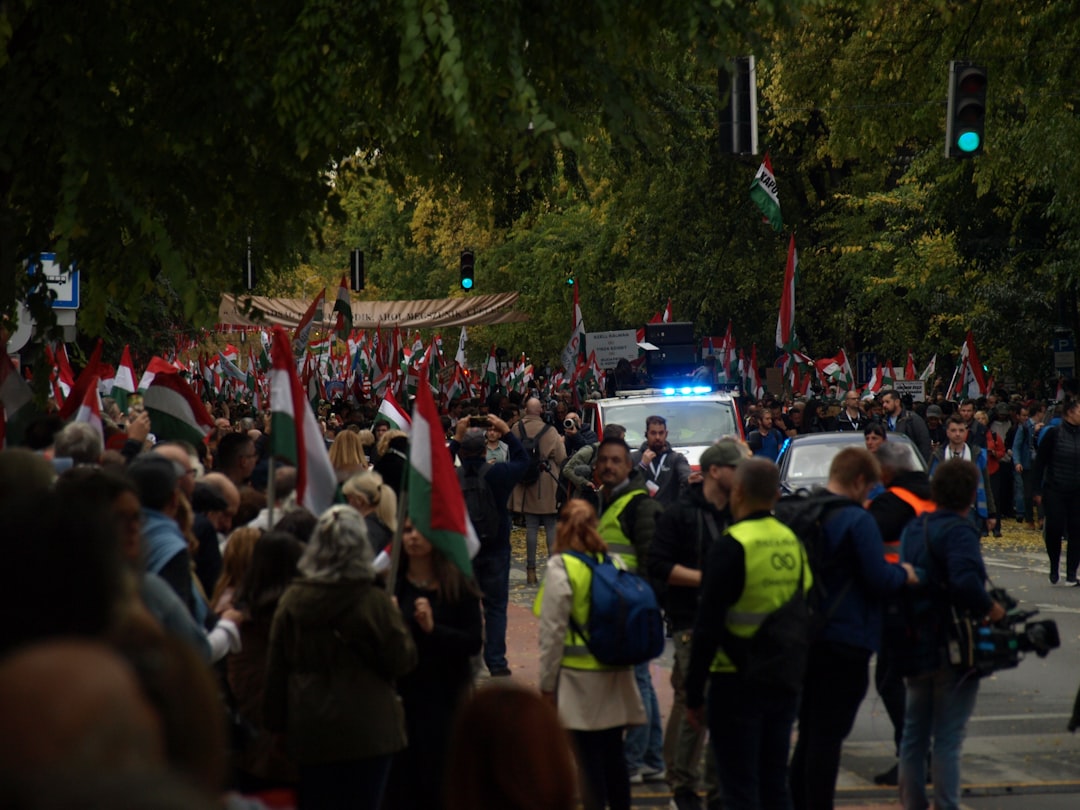
Visual evidence of Tisza's momentum extends beyond polling data. Images from a recent rally in Szigetszentmiklós, a town of just 30,000 residents in Pest County, showed massive crowds filling public spaces—an unusual sight for opposition politics in Hungary's countryside, where Fidesz has historically dominated.
The poll comes amid escalating campaign rhetoric from the government. Foreign Minister Péter Szijjártó declared Berlin, Brussels, and Kyiv as Hungary's "enemies" in recent remarks, while the government deployed military forces to energy facilities citing alleged Ukrainian threats—moves opposition figures characterize as election-year fearmongering.
In Hungary, as across the region, national sovereignty and European integration exist in constant tension. A potential Tisza victory would mark the end of Orbán's 14-year dominance of Hungarian politics and could fundamentally reshape Hungary's relationship with European institutions.
According to analysis by the Center for European Policy Analysis, Magyar "aims to end Hungary's 'swing diplomacy' and restore the country's credibility in Euro-Atlantic institutions." Unlike Orbán's pattern of vetoes and confrontational tactics with Brussels, Magyar has promised more constructive engagement while defending Hungarian interests.
The stakes extend far beyond Hungary's borders. Budapest has blocked Ukraine aid packages, vetoed EU sanctions against Russia, and challenged rule-of-law mechanisms for years, creating persistent friction with Western European capitals. A post-Orbán government would likely pursue unlocking approximately €18 billion in frozen EU funds—money withheld over rule-of-law concerns that have contributed more than half of Hungary's GDP growth since joining the bloc in 2004.
However, experts caution against expectations of seamless EU relations under Magyar. A European Policy Centre study noted that "Orbán's defeat would be symbolically significant, but it would not automatically resolve Hungary's tensions with Brussels." Both leaders align on contentious issues including some aspects of migration policy and budget negotiations, suggesting ongoing disagreements despite different diplomatic methods.
Opposition politician Dávid Vitézy recently exposed contradictions in the government's Ukraine messaging, revealing that Orbán himself signed documents in 2022 supporting Ukrainian military mobility with EU funds—directly contradicting current government rhetoric portraying Ukraine as a threat.
The government has responded to polling pressure with increasingly confrontational positions. Szijjártó claimed Ukraine benefits economically from war and accused Russia of merely defending itself—statements that contradict NATO's position and the international consensus, despite Hungary's continued membership in both NATO and the European Union.
With 46 days remaining until voters cast ballots, Magyar called on supporters to intensify campaign efforts ahead of the crucial March 15 national holiday—a date commemorating Hungary's 1848 revolution that Tisza plans to mark with nationwide demonstrations. "Let's hold on together, lift our heads, and do everything in every moment for regime change," Magyar wrote. "On April 12, tired but cheerful, holding hands and with love for our country in our hearts, let's step together through the gate of victory."
Political analyst Török emphasized the poll's potential accuracy while acknowledging uncertainty remains until election day. "What we don't know, neither I nor anyone else, and we won't know until April 12—we can only have opinions about it: can Medián be this wrong?" he wrote. "I, for one, would be very surprised if yes."