NOVI SAD — Men identified by witnesses and circulating social media posts as loyalists of Serbia's ruling Serbian Progressive Party (SNS) attacked students and assaulted a journalist in Novi Sad on Sunday evening, with multiple videos captured on mobile phones showing the violence in real time. The footage, posted across Serbian social networks within minutes of the assaults, represents some of the clearest visual documentation of organised intimidation against the country's year-long protest movement.
The most widely shared clip, posted to Reddit's r/serbia community under the title "SNS siledžije razbile nos mladiću a zatim nasrnule na novinara Razglasa" — roughly, "SNS thugs broke a young man's nose and then attacked a Razglas journalist" — shows a group of men approaching protesters before the assault. A separate video, posted shortly after midnight, shows a bloodied young man emerging from a police cordon. His injury, a broken nose according to eyewitnesses cited in subsequent posts, was consistent across multiple independent accounts.
A journalist from independent outlet Razglas, an online media organisation covering citizen protests in Serbia, was among those targeted. The journalist was apparently singled out after attempting to film the incident. A third video clip shows a group of men surrounding a young woman and forcibly taking her whistle — the symbol adopted by the protest movement — while uniformed police officers stood metres away without intervening.
<h2>Buses, Cordons and a Calculated Setting</h2>
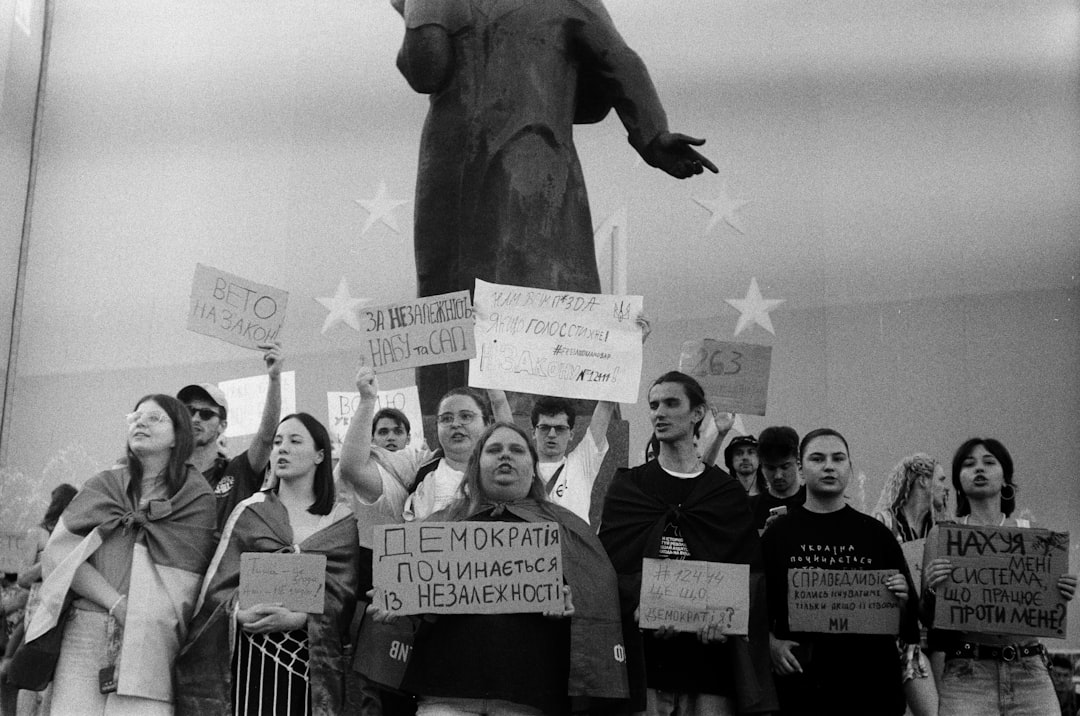
The violence did not occur in a vacuum. Earlier that evening, a large police deployment had established a cordon around the Serbian National Theatre in Novi Sad, protecting the venue's interior for a state ceremony marking the 200th anniversary of the founding of Matica Srpska — the prestigious Serbian cultural institution. President Aleksandar Vučić and senior officials attended. Outside, thousands of citizens had gathered in protest.
Multiple videos from the earlier hours of the evening show buses arriving in the area. In the Serbian protest vernacular, these are referred to as "ćaci-busevi" — colloquially, "thug buses" — a reference to the practice, documented at multiple prior flashpoints, of transporting organised groups of SNS-affiliated individuals to confront demonstrators. Attempts by citizens to block at least one such bus were captured on video and posted to Reddit around 10:20 p.m.
Posts identifying some of the alleged attackers by name and photograph circulated on Instagram within hours and were cross-posted to Reddit, where users with knowledge of local SNS networks appeared to corroborate at least some identifications. This outlet has not independently confirmed the identities of individuals shown in the footage, but the convergence of multiple independent video sources, eyewitness accounts and the crowd-sourced identification material establish a coherent and credible picture of what occurred.
<h2>A Movement Forged in Grief</h2>
The protest movement that has gripped Serbia for more than a year was triggered by the collapse of a concrete canopy at Novi Sad's main railway station on 1 November 2024, which killed sixteen people. The station had recently been renovated under a contract awarded by the government. Citizens, led initially by students and university faculty, demanded accountability — criminal prosecutions, parliamentary transparency and an end to what they characterised as entrenched impunity under Vučić's administration.
What began as a focused demand for answers over the station disaster evolved into a broader civic movement. By early 2026, protests had continued in Belgrade, Novi Sad, Kragujevac, Niš and dozens of smaller cities, sustained by student blockades of universities, walkouts by teachers and doctors, and the participation of civic organisations across the political spectrum. The whistle became the movement's emblem — its taking, therefore, was not incidental.
Sunday's events in Novi Sad carry a specific, bitter irony. The city where sixteen died is also where, on the same evening, a state celebration was underway for one of Serbia's most venerable cultural institutions — while, outside, people who have demanded justice for those sixteen deaths were being beaten.
<h2>Police Conduct Under Scrutiny</h2>
The visible passivity of uniformed police during the assaults is itself a significant element of the footage. In the video showing the woman having her whistle seized, officers are visible in the background and do not intervene. In a second clip, a young man emerges bleeding from within a police cordon — raising questions about what occurred inside the cordon and how he came to be there while injured.
By midnight, Predrag Baculov, a civic figure associated with the protest movement, had posted a short video in which he stated: "There weren't enough of us. Those who weren't there have no right to judge." His remarks reflected both the frustration of those present and a tacit admission that the movement's turnout in Novi Sad on the night had been uneven.
The Serbian interior ministry had not issued a public statement on the incidents at the time of publication. Government-aligned media had not prominently covered the violence.
<h2>EU Candidacy at Risk</h2>
The incidents arrive at a sensitive moment for Serbia's formal relationship with the European Union. In September 2025, the European People's Party opened an internal review of Vučić's party membership over concerns about democratic backsliding and alleged Russian connections. EU enlargement officials have repeatedly conditioned progress on Serbia's accession path on demonstrable improvements to the rule of law, media freedom and the protection of civil society.
Video evidence of organised violence by ruling-party affiliates against journalists and peaceful demonstrators — with police either complicit by inaction or actively facilitating the attackers' movements — is precisely the kind of documentation that European Parliament rapporteurs and Commission monitoring reports draw on when assessing candidate states. Brussels has not yet responded publicly to Sunday's events; a formal reaction is expected in the coming days.
In the Balkans, as across post-conflict regions, the path forward requires acknowledging the past without being imprisoned by it. The citizens outside the Serbian National Theatre on Sunday evening were doing exactly that: insisting that sixteen deaths be accounted for, and that a culture of impunity be broken. What they received was a broken nose and a stolen whistle. Whether Brussels treats this as a threshold moment or a footnote will say a great deal about the seriousness of European integration as a lever for democratic accountability in the Western Balkans.