NASA's Double Asteroid Redirection Test accomplished far more than deflecting a moonlet—new analysis reveals the kinetic impact altered the orbital trajectory of the entire binary asteroid system around the Sun, validating planetary defense concepts at a scale previously only modeled in simulations.
The mission, which deliberately crashed a spacecraft into the asteroid moonlet Dimorphos in September 2022, changed not only the moonlet's orbit around its parent asteroid Didymos but also shifted the paired system's heliocentric path, according to <link url='https://www.jpl.nasa.gov/news/nasas-dart-mission-changed-orbit-of-asteroid-didymos-around-sun/'>new findings from NASA's Jet Propulsion Laboratory</link>.
"We expected to move Dimorphos around Didymos," said Cristina Thomas, DART observation working group lead at Northern Arizona University. "What the new data shows is that momentum transfer was efficient enough to alter the center of mass of the entire binary system—shifting both asteroids' collective path through space."
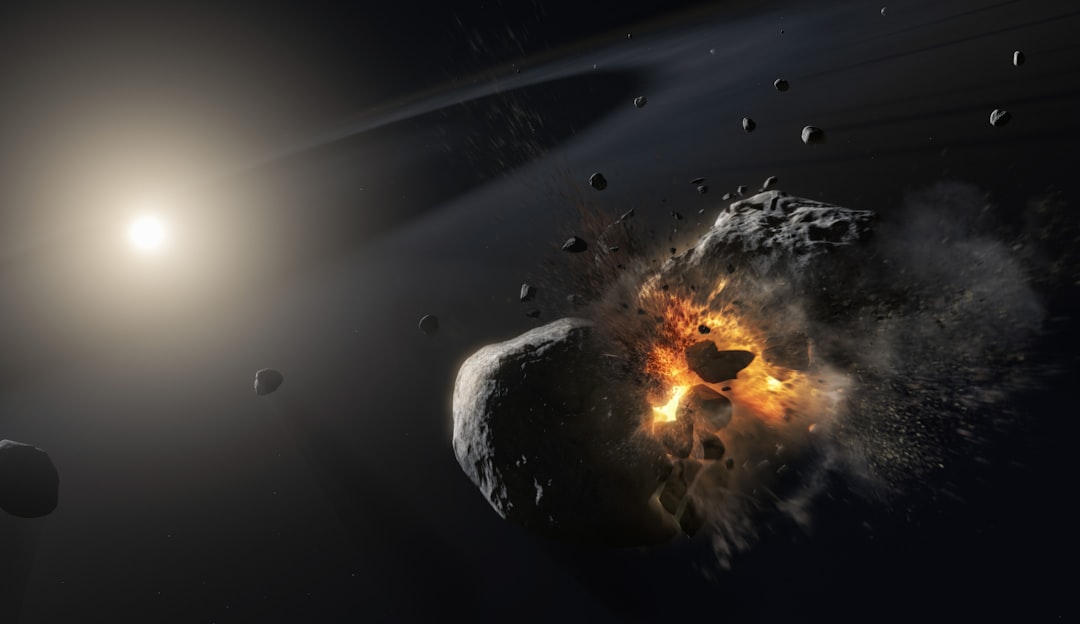
The kinetic impactor struck Dimorphos at approximately 6.6 kilometers per second, delivering momentum that changed the moonlet's orbital period around Didymos by 33 minutes—far exceeding the mission's minimum success threshold of 73 seconds. However, extended tracking revealed additional orbital mechanics at work.
Because Dimorphos and Didymos orbit their common center of mass while that system orbits the Sun, the momentum transferred to the smaller body propagated through the binary system's gravitational coupling. Think of it like a billiard ball collision where both balls are connected by a spring—striking one affects the motion of both.
In space exploration, as across technological frontiers, engineering constraints meet human ambition—and occasionally, we achieve the impossible. The DART mission demonstrated that kinetic impactor technology—essentially a guided spacecraft collision—can effectively deflect threatening asteroids, a capability crucial for planetary defense.
Ground-based radar observations from Goldstone and Arecibo observatories, combined with optical tracking from facilities worldwide, measured subtle changes in the Didymos system's solar orbit. While the shift amounts to only meters per second in velocity change, it confirms that binary asteroid systems respond to impacts differently than single bodies.
"This has significant implications for deflection mission planning," explained Nancy Chabot, DART coordination lead at Johns Hopkins Applied Physics Laboratory. "About 15 percent of near-Earth asteroids are binary systems. Understanding how they respond to kinetic impacts affects optimal targeting strategies."
The European Space Agency's Hera mission, scheduled to reach the Didymos system in 2026, will conduct detailed investigation of the impact crater and measure how the collision redistributed mass within the binary system. Hera carries instruments to map Dimorphos' interior structure and precisely measure both asteroids' masses—data essential for refining deflection models.
DART's success validated decades of theoretical work on kinetic impactor efficiency. The spacecraft's DRACO camera captured final approach images showing a rubble-pile surface, suggesting Dimorphos consists of loosely bound material rather than solid rock. This composition appears to enhance momentum transfer through ejecta—material blasted off the surface by impact, which acts like rocket exhaust in reverse.
Analysis of impact debris observed by the Italian Space Agency's LICIACube cubesat showed an ejecta cone extending thousands of kilometers, carrying significant mass away from Dimorphos. This ejected material contributed to the momentum change, effectively multiplying the impactor's effect beyond simple collision physics.
The modified solar orbit, while measurable, poses no hazard—neither Didymos nor Dimorphos threatens Earth, which is precisely why NASA selected this system for the first kinetic impact test. The asteroids orbit between Earth and Mars, allowing thorough pre-impact characterization and post-impact monitoring.
Planetary defense experts emphasize that DART demonstrated technology applicable to genuinely hazardous asteroids. Current surveys have catalogued approximately 90 percent of near-Earth asteroids larger than one kilometer, but tens of thousands of smaller bodies—still capable of regional devastation—remain undetected.
"DART proved we can hit a target we've barely seen, with a spacecraft traveling at hypervelocity, and achieve the desired deflection," noted Lindley Johnson, NASA's Planetary Defense Officer. "The system-level orbital change confirms our models work even for complex binary targets."
The mission cost $330 million—a fraction of potential damage from an unmitigated asteroid impact. Economic analyses suggest even city-scale impacts would cause hundreds of billions in damage, making deflection capability among the highest-return investments in planetary science.
Future planetary defense missions will build on DART's success, with proposals including kinetic impactors for larger asteroids, gravity tractors for gradual deflection, and even nuclear standoff burst concepts for genuinely massive threats detected with insufficient warning time for gentler methods.