More than three years after liberation from Russian occupation, Kherson has descended into a grim daily reality where residents navigate streets under constant threat from Russian drones and artillery positioned just across the Dnipro River, transforming the southern Ukrainian city into a testing ground for modern urban terror warfare.
Oleksandr Tolokonnikov, a 52-year-old teacher, describes his morning routine with matter-of-fact precision. "I listen for drones before I leave the apartment. I check the street from the window. I plan my route to avoid open spaces." Then he adds, quietly: "Sometimes I wonder if today is the day I don't make it home."
The psychological calculus of daily life in Kherson has been reduced to probability and timing. Residents interviewed by the Kyiv Independent describe a city where normal activities—shopping for groceries, walking to work, visiting neighbors—have become exercises in survival tactics against a patient, methodical enemy with clear line of sight.
Russian forces occupy the east bank of the Dnipro, elevated positions providing direct observation of Kherson's western districts. From these positions, they deploy reconnaissance drones to identify targets, then follow with FPV kamikaze drones or artillery strikes. The pattern is deliberate: not indiscriminate bombardment, but selective hunting of individual civilians.
"They watch us," says Iryna Koval, a 38-year-old nurse who continues working at a Kherson hospital despite the danger. "They see someone walking, they send a drone. They see a car, they target it. This isn't war—it's a manhunt."
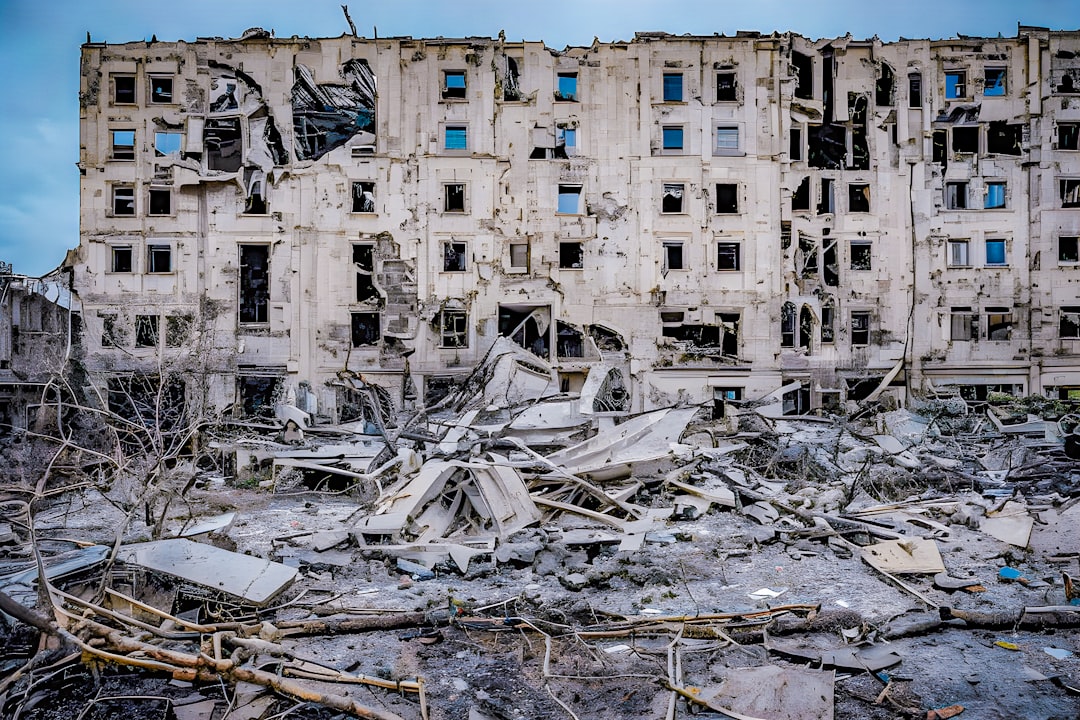
The regional administration building on the central square stands as testament to this systematic targeting, its facade torn away by repeated strikes, interior floors collapsed into rubble. Yet government offices continue operating in basement levels and nearby buildings, a stubborn insistence on maintaining civic function under impossible conditions.
In Ukraine, as across nations defending their sovereignty, resilience is not just survival—it's determination to build a better future. In Kherson, this resilience manifests in the approximately 50,000 residents who remain in a city that once housed over 280,000, choosing to maintain their community even as Russian forces attempt to make the city uninhabitable.
Dmytro Pletenchuk, a Ukrainian military spokesperson, explained the strategic calculus behind Russia's terror campaign. "They cannot occupy Kherson again, so they attempt to empty it. Every civilian who leaves is a victory for them, every one who stays is resistance."
The psychological toll compounds over time. Svitlana Petrovska, a 61-year-old former librarian, describes the erosion of hope. "The first months after liberation, we believed things would improve. Then another year passed. Then another. The shelling never stops. Friends leave. Buildings are destroyed. You begin to wonder if there's a future here."
Yet alongside despair exists defiance. Local volunteers continue delivering humanitarian aid to elderly residents unable or unwilling to evacuate. Teachers conduct classes in basement shelters. Small businesses operate from reinforced premises, opening when artillery quiets, closing when danger escalates.
Andriy Hrechko, a 43-year-old café owner, reopened his business six months ago despite the risks. "If everyone leaves, Russia wins. If we stay, if we maintain something resembling normal life, we prove they cannot break us." He pauses, listening to a distant explosion. "Though some days I question this logic."
Ukrainian military forces work to suppress Russian artillery and drone operations, but the proximity of enemy positions—often less than two kilometers from residential areas—makes comprehensive defense nearly impossible. Electronic warfare systems jam some drones; mobile air defense intercepts some projectiles. But in a city where dozens of drones operate daily, many slip through.
Medical workers describe treating injuries unlike conventional warfare wounds. FPV drone strikes cause distinctive patterns of blast and shrapnel trauma. Koval, the nurse, has seen children wounded while playing near their homes, elderly people struck while tending gardens, workers killed traveling to essential jobs.
"Every casualty is deliberate," she emphasizes. "These are not stray shells from distant artillery. These are targeted attacks on identified individuals. It's terrorism with precision weapons."
International humanitarian organizations have documented systematic targeting of civilians in Kherson, with reports submitted to war crimes investigators. But documentation brings little comfort to residents navigating immediate danger. The question for many is not whether international justice will eventually arrive, but whether they will survive until it does.
As winter transitions to spring, Kherson faces another season under the shadow of Russian positions across the river. Reconstruction efforts remain minimal—there is little point repairing buildings that will be targeted again. Instead, the city adapts: reinforced basements, underground passages between buildings, warning systems that alert residents when drones are detected overhead.
Tolokonnikov, the teacher, reflects on why he stays despite having relatives in safer regions who invite him to leave. "This is my city. My students are here—the ones whose families cannot leave. If I abandon them, what am I?" He shrugs. "So I teach. I plan my route carefully. I listen for drones. And I hope that someday, we will not have to live this way."
In Kherson, liberation has not brought peace—only a different form of war, one where the front line is everywhere and nowhere, where civilians become primary targets, and where daily life itself becomes an act of resistance against an enemy determined to make the city unlivable. Yet tens of thousands remain, maintaining community against all logic, their presence itself a refusal to grant Russia its objective of emptying Ukrainian lands.