
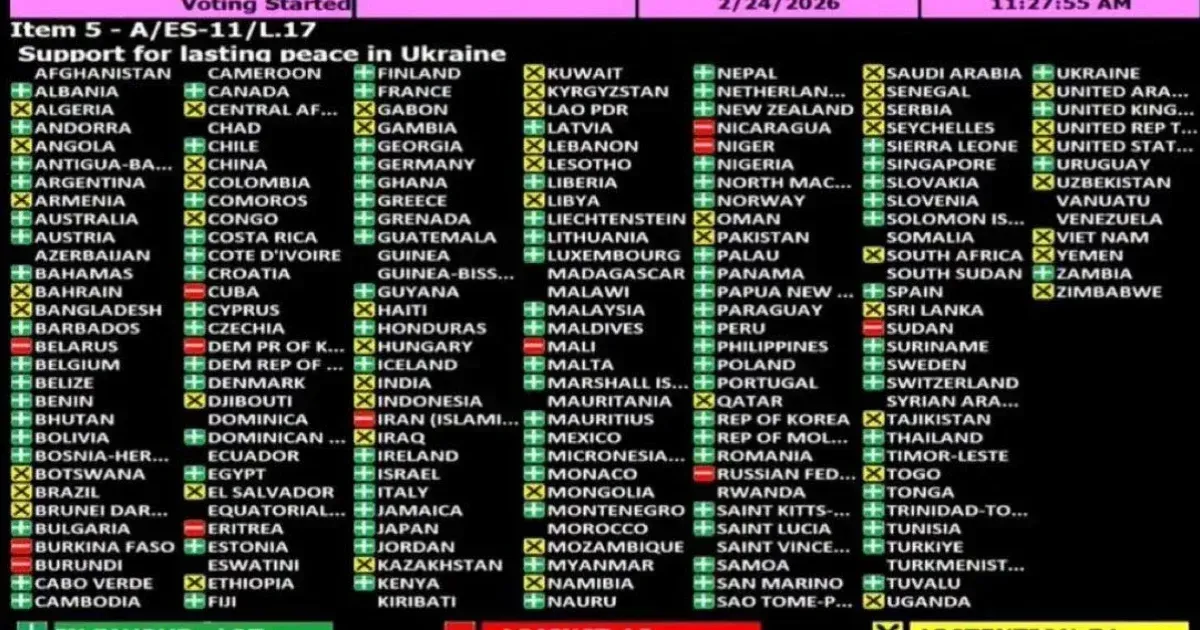
<strong>Budapest</strong> — Hungary was the only European Union member state that did not support a United Nations resolution calling for peace in Ukraine, highlighting the government's continued divergence from the European consensus on the war and raising fundamental questions about whether the bloc can maintain a common foreign policy when one member consistently sides with positions closer to the Kremlin.The UN General Assembly adopted the resolution with 107 votes in favor and 12 against, with 51 abstentions. Hungary joined a group of abstaining nations that included the United States, China, India, and Brazil—but was conspicuously alone among the 27 EU member states in refusing to back the measure.The resolution expressed concerns about Russian attacks on civilians and infrastructure, defended Ukraine's sovereignty and territorial integrity, and demanded an immediate, unconditional ceasefire. Those voting against included Russia, Belarus, North Korea, Cuba, Iran, and several African nations.<h2>Government Defends 'Sovereign' Stance</h2>Hungarian officials characterized the country's position as "a sovereign, pro-peace abstention," framing the decision within the government's longstanding narrative that prioritizes negotiated settlement over continued military support for Ukraine.The Orbán administration has consistently argued that Western military assistance prolongs the conflict rather than hastening its conclusion. Government spokespeople have emphasized Hungary's geographical proximity to the war and the country's economic exposure to energy disruptions as justifications for maintaining a distinct position within the EU."Hungary's national interest requires peace, not escalation," government officials have stated repeatedly throughout the conflict, positioning Budapest as a voice for diplomatic solutions while other European capitals focus on military support and sanctions against Russia.<h2>Opposition Criticizes Isolation</h2>Hungarian opposition parties swiftly condemned the abstention as evidence of the government's alignment with Moscow rather than with Hungary's European partners.Critics note that Hungary's position leaves it isolated not only within the EU but also within the Visegrád Group of Central European nations. Poland, the Czech Republic, and Slovakia—Hungary's traditional regional allies—all supported the resolution, reflecting their own security concerns about Russian aggression near their borders."When Hungary stands alone among EU members, we are not exercising sovereignty—we are abandoning our alliances," opposition figures argued, pointing to the pattern of Hungarian positions on Ukraine-related matters consistently aligning with Russian preferences rather than European consensus.The abstention follows a similar pattern from months earlier, when Hungary declined to support a UN resolution on international cooperation following a Russian drone attack on the Chernobyl nuclear facility.<h2>EU Foreign Policy Fractures</h2>The vote underscores the fundamental tension within the European Union over foreign policy decision-making. While Brussels seeks to present a unified front on Ukraine, Hungary's consistent divergence reveals the limits of that ambition when member states retain sovereignty over their UN votes.Unlike EU sanctions packages, which require unanimous approval and thus give Hungary blocking power, UN General Assembly votes are individual national decisions. Hungary's isolation in this forum is therefore more visible and politically significant, as it represents an active choice to distance Budapest from its EU partners rather than merely exercising a veto right.European diplomats have expressed frustration with what they characterize as Hungary's obstruction of EU foreign policy objectives. Budapest has repeatedly delayed or weakened EU sanctions against Russia, blocked financial and military aid packages to Ukraine, and maintained close diplomatic and economic ties with Moscow even as other member states severed such connections.<h2>Domestic Political Context</h2>The UN vote occurred as Hungary approaches parliamentary elections in April, with the government framing its position on Ukraine as part of a broader "peace policy" that resonates with voters concerned about energy costs, inflation, and the risk of broader regional conflict.Government-aligned media has emphasized Hungary's economic vulnerabilities and the potential costs of antagonizing Russia, while opposition media highlights the country's isolation within Europe and questions about the government's relationship with Moscow.Public opinion in Hungary on Ukraine policy remains divided. Government supporters tend to prioritize avoiding direct involvement in the conflict and maintaining energy supplies, while opposition supporters are more likely to favor alignment with EU policy and support for Ukraine.<h2>Regional Dynamics Shift</h2>Hungary's stance contrasts sharply with the positions of its Visegrád Group partners, illustrating how the war has reshaped Central European politics.Poland, which shares a border with Ukraine and has hosted millions of Ukrainian refugees, has become one of Kyiv's strongest supporters within the EU. The Czech Republic and Slovakia, despite their own historical ties to Russia, have both backed EU policy on Ukraine more consistently than Hungary.This divergence has strained traditional regional cooperation mechanisms. The Visegrád Group, once a unified voice within the EU on issues ranging from migration to budget negotiations, has fractured over Ukraine policy, with Hungary increasingly isolated from its former allies.<h2>Questions About European Unity</h2>The episode raises fundamental questions about the EU's ability to conduct effective foreign policy when member states hold divergent views on core security matters.Some European officials argue that Hungary's position undermines the bloc's credibility and effectiveness, particularly when dealing with Russia. Others acknowledge that genuine disagreements exist within the EU about the appropriate response to the conflict and that unity cannot be manufactured through pressure alone.In Hungary, as across the region, national sovereignty and European integration exist in constant tension. The Orbán government has successfully framed its Ukraine policy as an assertion of Hungarian independence and national interest, even as critics characterize it as alignment with an adversary at the expense of European partnerships.The UN vote represents more than a procedural matter—it illustrates the deeper challenge facing the European Union as it attempts to forge common foreign policy positions among 27 diverse member states with distinct historical experiences, geographical positions, and political calculations.Whether this divergence represents a temporary friction point or a more fundamental fracture in European unity will depend partly on the evolution of the conflict itself, partly on domestic political developments within Hungary, and partly on how the EU institutions choose to respond to persistent policy disagreements among member states.
|