

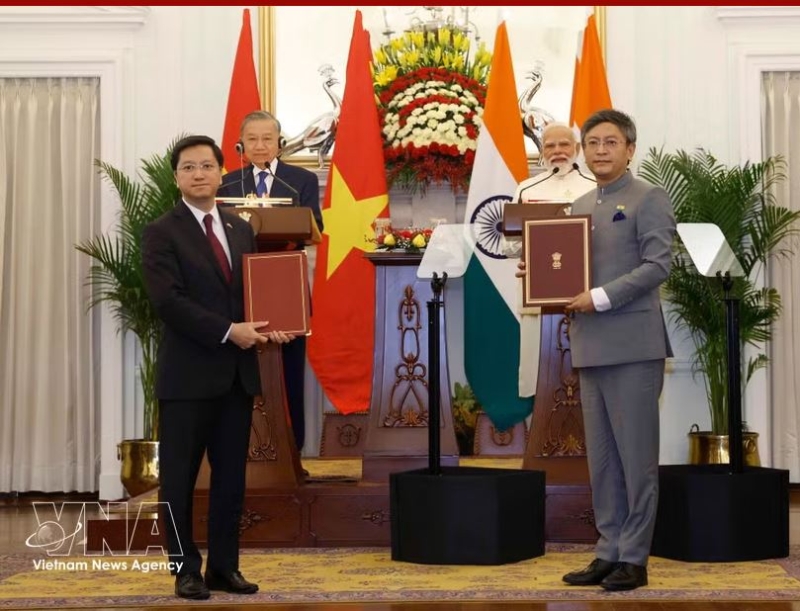
Vietnam and India signed agreements establishing bilateral QR code-based payment connectivity, allowing direct currency transactions between the two nations without relying on the US dollar as an intermediary.
The memorandum of understanding between Vietnam's State Bank and India's Reserve Bank of India, signed during Party General Secretary and President To Lam's state visit, marks the third such arrangement for Hanoi following similar deals with China and South Korea.
The payment corridor connects Vietnam's National Payment Corporation with NPCI International Payments Limited, enabling Vietnamese and Indian consumers and businesses to conduct direct transactions in Vietnamese dong and Indian rupees. A Vietnamese tourist in Mumbai can now pay for a hotel using a Vietnamese QR code that settles directly in rupees, bypassing dollar conversion fees and exchange rate risks.
In Vietnam, as across pragmatic one-party states, economic opening proceeds carefully alongside political stability. The payment network strategy reflects Hanoi's characteristic balancing act: building economic ties across multiple geopolitical camps while reducing dependence on any single currency or partner.
The agreements serve Vietnam's broader de-dollarization strategy while avoiding the appearance of picking sides in great power competition. With payment corridors now spanning China, India, and South Korea—nations representing different geopolitical alignments—Vietnam maintains its carefully calibrated neutrality while capturing practical economic benefits.
For India, the agreement advances Prime Minister Narendra Modi's push to internationalize the rupee and strengthen financial connectivity across Asia. The bilateral QR payment system follows India's successful domestic UPI platform, which processes billions of transactions monthly.
The timing reflects broader Asian moves away from dollar dominance in regional trade. China and Russia increasingly settle transactions in yuan and rubles, while ASEAN nations explore local currency arrangements. Vietnam's approach differs by building parallel bilateral corridors rather than joining a single alternative system.
Economists note the arrangements reduce transaction costs for the approximately $15 billion in annual trade between Vietnam and India, particularly benefiting small and medium enterprises that previously faced high currency conversion fees. Tourism flows also stand to benefit, with direct payment reducing costs for the growing number of Indian visitors to Vietnam.
The payment connectivity emerged from broader cooperation agreements signed during the state visit, which also covered defense cooperation, technology transfer, and pharmaceutical trade. The financial dimension, however, carries particular strategic weight as both nations navigate relationships with Washington and Beijing.
Vietnam's manufacturing boom has positioned it as a key alternative to China in global supply chains, attracting American investment and security cooperation. Yet China remains Vietnam's largest trading partner and an unavoidable northern neighbor. The payment network strategy allows Hanoi to deepen economic integration across Asia without committing to any particular geopolitical alignment.
Central bank officials from both countries emphasized the technical and commercial benefits rather than geopolitical implications, noting the arrangements simply modernize payment infrastructure to match existing trade flows. Yet the cumulative effect of such bilateral agreements gradually reduces the dollar's role in Asian commerce—even if no single agreement dramatically shifts currency dynamics.
The success of these payment corridors will depend on adoption rates among businesses and consumers, regulatory harmonization between national systems, and sustained political commitment from both governments. Vietnam's existing corridor with China has seen steady growth, suggesting practical demand exists for dollar alternatives in regional transactions.
As other Southeast Asian nations watch Vietnam's approach, the bilateral payment strategy may offer a template for countries seeking to reduce currency costs without joining formal de-dollarization initiatives that might antagonize Washington. The model preserves flexibility while capturing economic benefits—a characteristically Vietnamese approach to navigating great power competition.


