
The Pentagon has abruptly canceled the planned deployment of more than 4,000 U.S. soldiers to Poland, raising urgent questions about American commitment to NATO's eastern flank at a moment when Russian aggression shows no sign of abating.
The 2nd Armored Brigade Combat Team from Fort Hood, Texas had already completed pre-deployment ceremonies on May 1, with advance elements already in Poland and equipment in transit when the deployment was suddenly called off. The decision leaves Polish defense planners scrambling to recalibrate security arrangements along NATO's most vulnerable border.
<strong>In Poland, as across Central Europe, history is never far from the surface—and neither is the memory of occupation.</strong>
The cancellation comes amid what U.S. Senator Jack Reed describes as "a budget shortfall of at least $2 billion" facing the Army, though military officials speaking to ABC News put the actual figure between $4 billion and $6 billion. Whatever the exact number, Poland is paying the price for Washington's fiscal challenges.
<h2>A Pattern of Retreat</h2>
This is not an isolated incident. The Pentagon announced in April that approximately 5,000 U.S. troops would be withdrawn from Germany. Together, these moves will reduce American military presence in Europe to pre-2022 levels—the period before Russia's full-scale invasion of Ukraine, which has resulted in over 43,000 Ukrainian casualties and at least 100,000 Russian deaths.
The timing could hardly be worse. Just days ago, the Russian Duma passed legislation formally authorizing President Vladimir Putin to deploy military forces abroad—codifying what had previously been executive action into law. For Poland and the Baltic states, such legal formalization is more than procedural theater; it represents Russia systematically preparing the ground for future military operations.
<h2>Warsaw's Dilemma</h2>
Polish officials have not yet issued public statements on the cancellation, but Warsaw sources said privately that the decision came as a shock. Poland has positioned itself as one of NATO's most committed members, meeting defense spending targets while serving as the primary logistics hub for Western military assistance to Ukraine.
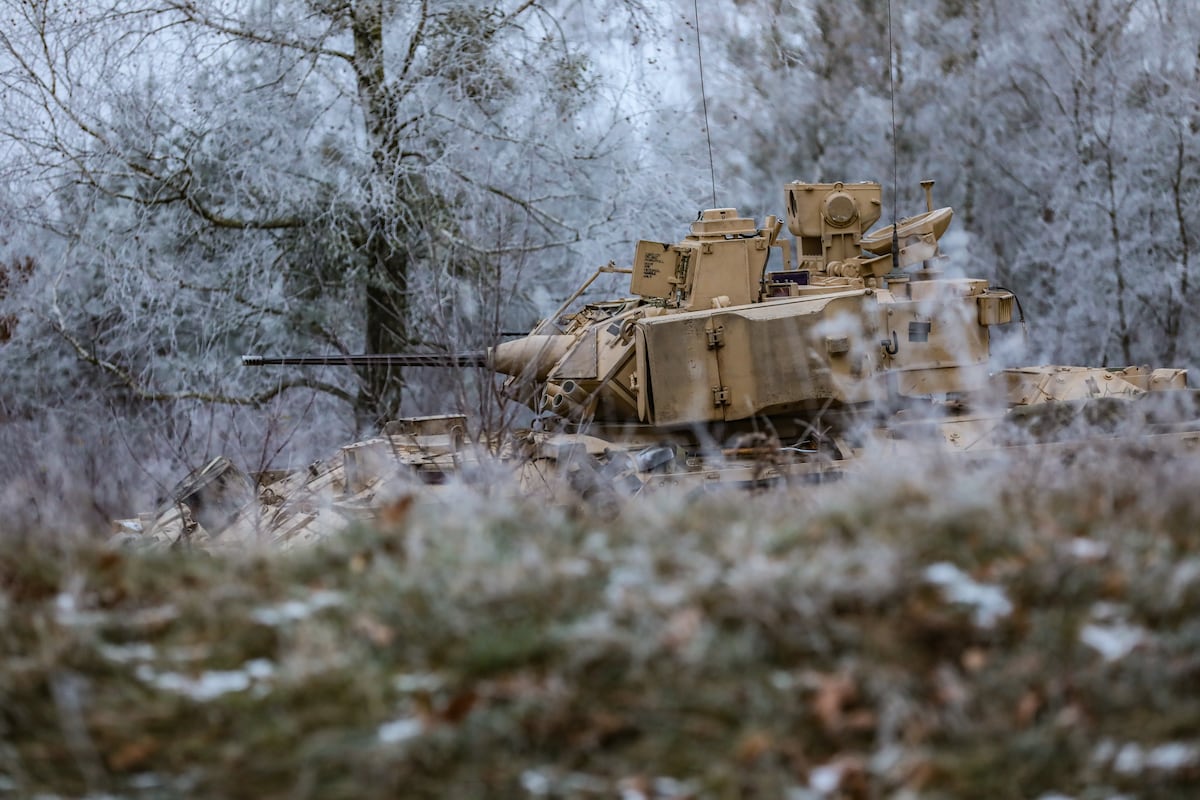
The deployment was meant to be part of the rotating U.S. military presence that has reassured eastern NATO members since Russia's 2014 annexation of Crimea. The Fort Hood brigade would have brought tanks, armored fighting vehicles, and artillery—precisely the heavy armor that makes a credible deterrent against Russian mechanized forces.
Both the Army and the Defense Department declined to provide detailed explanations for the cancellation. An Army official confirmed the decision but "referred all questions to the Defense Department," which offered only: "We have no comment on this at this time."
<h2>The Historical Echo</h2>
For Poles, American security guarantees have always been viewed through the prism of historical abandonment. Poland's 20th century history is defined by betrayals: the Nazi-Soviet Pact of 1939, the Western powers' inability to defend Poland from invasion, and the Yalta Conference that consigned Poland to Soviet domination.
Poland joined NATO in 1999 precisely to ensure that such abandonment could never happen again. For two decades, that bet appeared to have paid off. But decisions like this deployment cancellation—made unilaterally, with minimal consultation, driven by domestic budgetary concerns rather than strategic necessity—revive old anxieties.
<h2>Poland's Response</h2>
Poland has not sat idle while Washington wobbles. The Polish government announced plans in 2023 to expand the army to 300,000 soldiers, making it one of Europe's largest militaries. Warsaw has ordered advanced F-35 fighter jets, HIMARS rocket artillery, and Abrams tanks from the United States, while pursuing arms deals with South Korea for K2 tanks and K9 self-propelled howitzers.
These purchases represent a hedge—a recognition that Poland may need to provide more of its own security than NATO's Article 5 guarantee once implied. The deployment cancellation will only accelerate this strategic recalculation.
<h2>Broader European Implications</h2>
The signal this sends extends beyond Poland. The Baltic states—Estonia, Latvia, and Lithuania—rely on the same American military presence as a deterrent. If budget pressures in Washington can cancel a deployment to Poland on short notice, what confidence can Tallinn or Vilnius have in American commitments?
European defense officials have spent years warning that the continent needs to take greater responsibility for its own security. This moment may force that reckoning to arrive faster than anyone anticipated.
The Russian threat has not diminished. Moscow's new law authorizing foreign military operations, combined with continued casualties in Ukraine, demonstrates Putin's willingness to accept extraordinary costs in pursuit of geopolitical objectives. Poland understands this reality with a clarity born of geography and history.
Whether Washington does remains an open question.