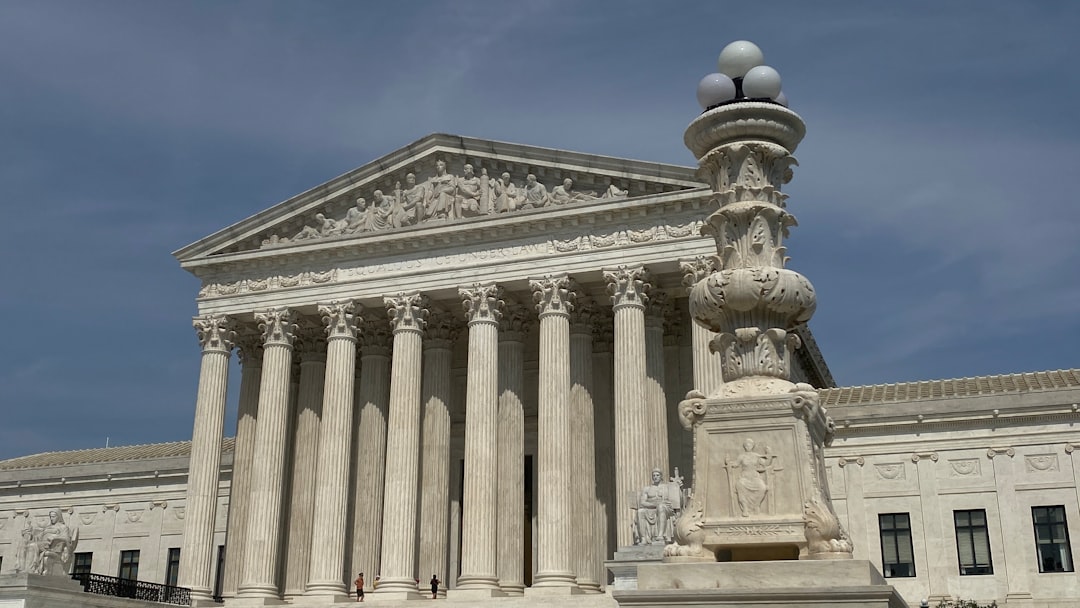
A Supreme Court challenge to federal greenhouse gas regulations rests on a factual claim that contradicts established climate science, according to legal scholars and atmospheric scientists reviewing the case's underlying premises.
The case, brought by Republican-led states and industry groups, seeks to restrict the EPA's authority to regulate carbon dioxide emissions under the Clean Air Act. Central to the plaintiffs' argument is the assertion that climate science remains too uncertain to justify comprehensive emission regulations—a claim that legal experts say is demonstrably false.
"The case treats climate science as if it's still in the 1980s," said Lisa Heinzerling, professor of environmental law at Georgetown University. "We have overwhelming scientific consensus, decades of observations confirming model predictions, and documented climate impacts already underway. The uncertainty premise is simply wrong."
The Intergovernmental Panel on Climate Change has concluded with "unequivocal" certainty that human activities have warmed the planet. The IPCC's Sixth Assessment Report, synthesizing over 14,000 peer-reviewed studies, found that global surface temperature has increased 1.1°C since pre-industrial times, with human influence as the dominant cause.
More than 99 percent of peer-reviewed climate studies now agree on anthropogenic warming, according to research published in Environmental Research Letters. This level of consensus exceeds that for many other scientific theories that inform regulatory policy.
Yet the Supreme Court case argues that "significant scientific uncertainty" should limit EPA regulatory authority. Legal scholars warn this framing could establish a precedent that paralyzes federal action on any complex environmental challenge.
"If scientific certainty becomes the standard for regulation, nothing gets regulated," said Richard Lazarus, professor of environmental law at Harvard Law School. "Science doesn't provide certainty—it provides probabilities. The climate probabilities are now extremely high."
The case arrives at the Court following a series of decisions that have narrowed federal regulatory authority. The 2022 West Virginia v. EPA ruling invoked the "major questions doctrine" to limit EPA climate authority, requiring explicit Congressional authorization for economically significant regulations.
The current case extends that logic, arguing that even explicit statutory authority—the Clean Air Act's mandate to regulate air pollutants that endanger public health—cannot justify comprehensive greenhouse gas controls given alleged scientific uncertainty.
"This is regulatory nihilism dressed up in legal theory," said Jody Freeman, founding director of Harvard's Environmental and Energy Law Program. "It would make federal climate policy effectively impossible, regardless of what Congress authorizes or science demonstrates."
Climate scientists say the scientific premise of the case contradicts established atmospheric physics. The greenhouse effect of CO2 has been experimentally verified since the 1850s. Satellite measurements confirm increased downward infrared radiation at wavelengths absorbed by greenhouse gases, directly demonstrating the mechanism of warming.
"We can measure the radiative forcing," said Dr. Michael Mann, Presidential Distinguished Professor at the University of Pennsylvania. "We observe the warming. We attribute it to human emissions with statistical confidence exceeding five sigma—the same standard particle physicists use to confirm new particles."
The case could reshape not only climate policy but environmental regulation broadly. The Clean Air Act has served as the statutory foundation for regulations on lead, mercury, particulate pollution, and acid rain—all based on scientific evidence of harm that, while robust, carries inherent uncertainties.
"Every pollutant regulation involves scientific judgment under uncertainty," said David Doniger, senior strategic director of the Natural Resources Defense Council's Climate and Clean Energy Program. "That's why Congress gave EPA scientific expertise and regulatory authority. This case would transfer technical decisions to judges."
Legal observers note the Supreme Court's current composition shows skepticism toward federal regulatory power, particularly on issues with significant economic implications. The Court's 6-3 conservative majority has signaled openness to limiting agency authority through doctrines like "major questions" and nondelegation.
In climate policy, as across environmental challenges, urgency must meet solutions—science demands action, but despair achieves nothing. The Supreme Court case demonstrates how legal challenges can obstruct climate policy even when scientific consensus is overwhelming.
International climate negotiators are watching closely. The United States committed under the Paris Agreement to reduce greenhouse gas emissions 50-52 percent below 2005 levels by 2030. EPA regulations on power plants, vehicles, and industrial sources are essential to meeting that target.
"U.S. climate credibility is on the line," said Rachel Cleetus, policy director for the Union of Concerned Scientists' Climate and Energy Program. "If the Supreme Court blocks EPA authority, the U.S. cannot meet its international commitments. That undermines global climate negotiations."
The timing is particularly critical as global emissions approach levels that risk exceeding the Paris Agreement's 1.5°C warming limit. The UN Emissions Gap Report found the world is on track for 2.7°C warming by 2100 under current policies—a trajectory that climate science indicates would produce catastrophic impacts.
Legal scholars emphasize that Congress designed the Clean Air Act specifically to grant EPA authority to regulate newly identified air pollutants based on evolving scientific understanding. The statute's flexible language anticipated that pollutants not known in 1970 might require regulation as science advanced.
"Congress couldn't enumerate every future pollutant," said Ann Carlson, professor at UCLA School of Law. "They created a science-based framework where EPA identifies harmful pollutants and sets protective standards. That's how environmental law is supposed to work."
The case will be argued in the Court's current term, with a decision expected by June 2026. Environmental law experts warn the ruling could determine whether the federal government can respond to climate change through existing statutory authority—or whether climate policy requires new Congressional action in a polarized political environment where major climate legislation appears unlikely.
For climate advocates, the case represents a paradox: climate science has never been more certain, yet legal challenges increasingly invoke uncertainty to block regulatory action. The Supreme Court's resolution of this tension will shape U.S. climate policy for decades.