
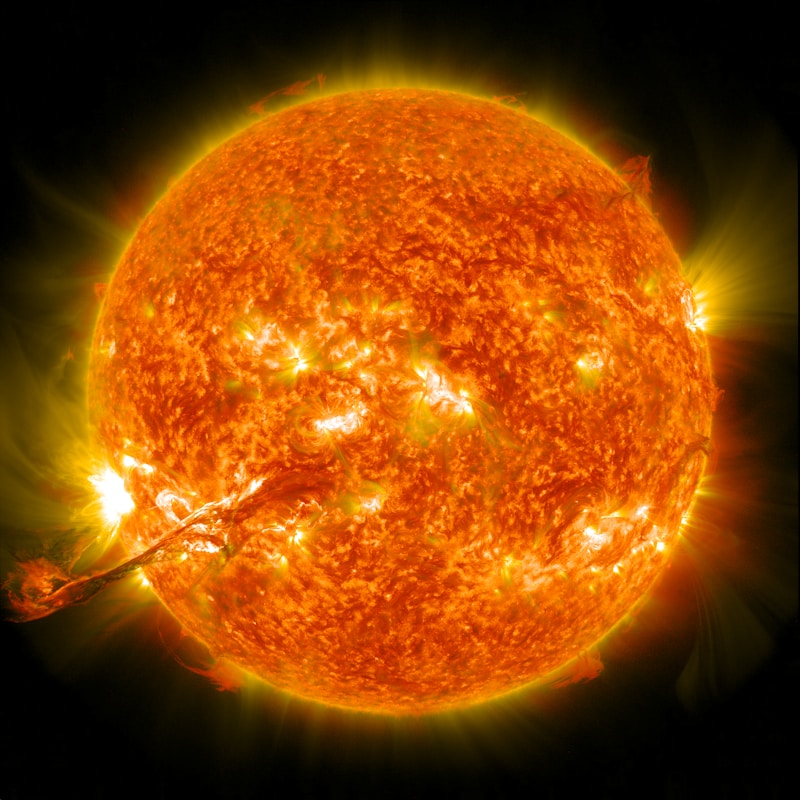
An S4 (Severe) solar radiation storm began blasting Earth on January 19th, marking the strongest such event since the legendary Halloween storms of October 2003. And as of late Sunday evening UTC, it was still intensifying.
NOAA's Space Weather Prediction Center issued alerts to airlines, NASA, the FAA, and emergency management agencies as radiation levels climbed past thresholds not seen in 23 years. The storm exceeds the intensity of those 2003 events, which caused satellite damage, knocked out power grids in Sweden, and forced airlines to reroute dozens of flights.
So what does an S4 storm actually do? Three things, mostly:
First, radiation exposure. Astronauts aboard the International Space Station face elevated doses—not immediately dangerous, but enough that mission planners start calculating cumulative exposure limits. Airlines operating polar routes (say, New York to Tokyo over the Arctic) face the same calculus for flight crews. At high latitudes, Earth's magnetic field offers less shielding, so radiation from the storm penetrates deeper into the atmosphere.
Second, satellite risk. Geostationary satellites—the ones that handle weather monitoring, communications, and GPS—sit in the storm's direct path. High-energy protons can flip bits in memory chips, degrade solar panels, or in extreme cases, fry electronics entirely. Launch operations also face delays; nobody wants to send a rocket through a radiation barrage.
Third, communications blackouts. High-frequency radio systems in polar regions—used for aviation, maritime operations, and military communications—experience complete loss of over-the-horizon capability during S4 events. Planes reroute, ships switch to satellite phones, and ham radio operators sigh heavily.
Now, the important context: we're currently near the peak of Solar Cycle 25. The Sun goes through roughly 11-year cycles of activity, and we're in the noisy part right now. More sunspots mean more solar flares, and occasionally, more radiation storms.
What NOAA hasn't said is how long this will last or what caused it. Radiation storms typically follow major solar flares, but the agency's alert didn't specify a triggering event. That's... interesting. Either the flare occurred on the Sun's far side (meaning we only caught the particle spray), or there's something else going on.