
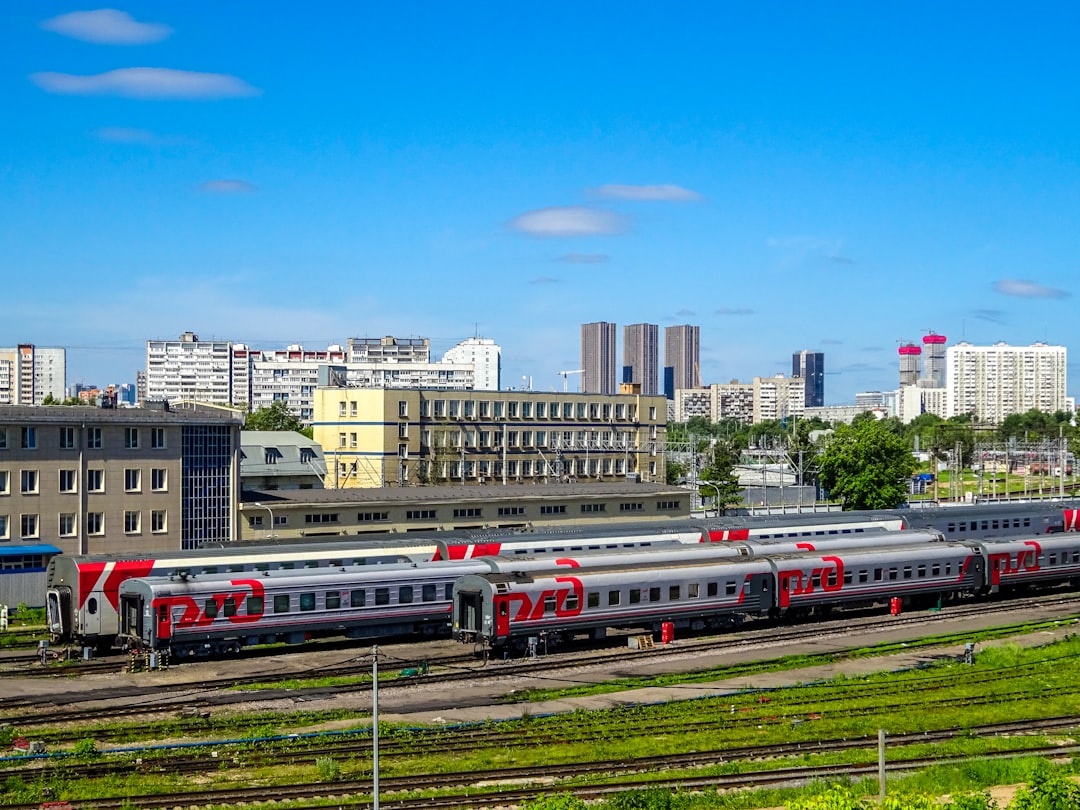
MOSCOW — Russia's state railway monopoly has reached a point of financial collapse so severe that one analyst has described it as having "essentially gone bankrupt," with the Kremlin now engineering an emergency rescue package that illuminates the deepening strains of a war economy attempting to sustain itself on increasingly strained foundations.
According to reporting by The Moscow Times, the government has approved a 1.3 trillion ruble assistance package for Russian Railways (RZhD), the state-owned freight and passenger network that serves as the circulatory system of the Russian economy — and, since February 2022, an indispensable artery for military logistics.
The scale of the deterioration is striking. Since the full-scale invasion of Ukraine, RZhD has lost 14 percent of its freight transportation volume, accumulated 4 trillion rubles in debt, and posted its first net loss since the pandemic. Over the first nine months of the current fiscal year alone, the company recorded 4.4 billion rubles in net losses. Workers have been placed on unpaid leave, investment programs slashed by 25 percent — from 890.9 billion to 713.6 billion rubles — and the company is now being directed to liquidate significant assets, including a 62-story tower in the Moscow-City financial district purchased for 193.1 billion rubles in 2024, and Moscow's historic Riga railway station.
Starting March 1, 2026, the government will impose a 1 percent emergency tariff increase on cargo transportation across the RZhD network. According to Reuters calculations cited by The Moscow Times, that measure generates roughly 22.3 billion rubles — a meaningful but limited contribution toward a liability of vastly greater magnitude. RZhD had previously requested 200 billion rubles from the National Welfare Fund; the Finance Ministry approved only 65 billion.
The condition of the National Welfare Fund itself warrants context that the Kremlin prefers not to foreground. Originally established as a long-term reserve for pension obligations, the fund has been drawn upon repeatedly since 2022 to plug holes opened by international sanctions, underwrite defense-sector expansion, and subsidize state enterprises under pressure. Its available liquid assets have contracted significantly, leaving the government with fewer emergency levers than it held at the war's outset. The 1.3 trillion ruble rescue package for RZhD — which includes debt restructuring in addition to direct transfers — arrives as that fund is already stretched across multiple competing demands.
For ordinary Russian citizens, the freight tariff hike carries indirect but real consequences. Russia is a country of continental dimensions in which rail remains the dominant mode for transporting food, fuel, construction materials, and consumer goods — particularly to Siberia and the Russian Far East, regions already contending with elevated costs and constrained supply chains. Tariff increases imposed on freight shippers cascade through supply chains, ultimately manifesting as price pressure at the consumer level. In a period when inflation is already a persistent political irritant for the Kremlin, the optics of raising transport costs are uncomfortable, even if managed through gradual increments.
For military planners, the picture is more acutely concerning. RZhD's rail network is not merely a commercial infrastructure: it is the backbone of Russia's ability to move heavy equipment, ammunition, fuel, and personnel over vast distances to the front. A financially hollowed-out RZhD — one cutting maintenance investments by a quarter, shedding workers, and divesting assets — is a network whose long-term reliability and capacity must be viewed with growing skepticism by military logistics officers. Deferred maintenance on rolling stock and track in a network already operating under unusual wartime loads creates accumulating operational risk that does not disappear simply because a balance sheet has been temporarily stabilized.
In Russia, as in much of the former Soviet space, understanding requires reading between the lines. Soviet industrial planning embedded railways into the national security architecture in ways that made them structurally inseparable from state power. The Kremlin's willingness to authorize an emergency rescue of this scale — including the politically sensitive step of directing asset sales and imposing tariff hikes on an already-strained freight sector — speaks to how seriously officials regard the risk of RZhD's dysfunction.
What the rescue does not resolve is the underlying structural tension: a state enterprise of this size, carrying debt of 4 trillion rubles, cannot be sustained indefinitely through emergency transfers from a fund that is itself under pressure. The short-term bailout buys time. What happens when that time runs out — and whether the war's trajectory will have shifted the financial picture by then — is the question that Russia's economic planners are, for now, declining to answer publicly.