
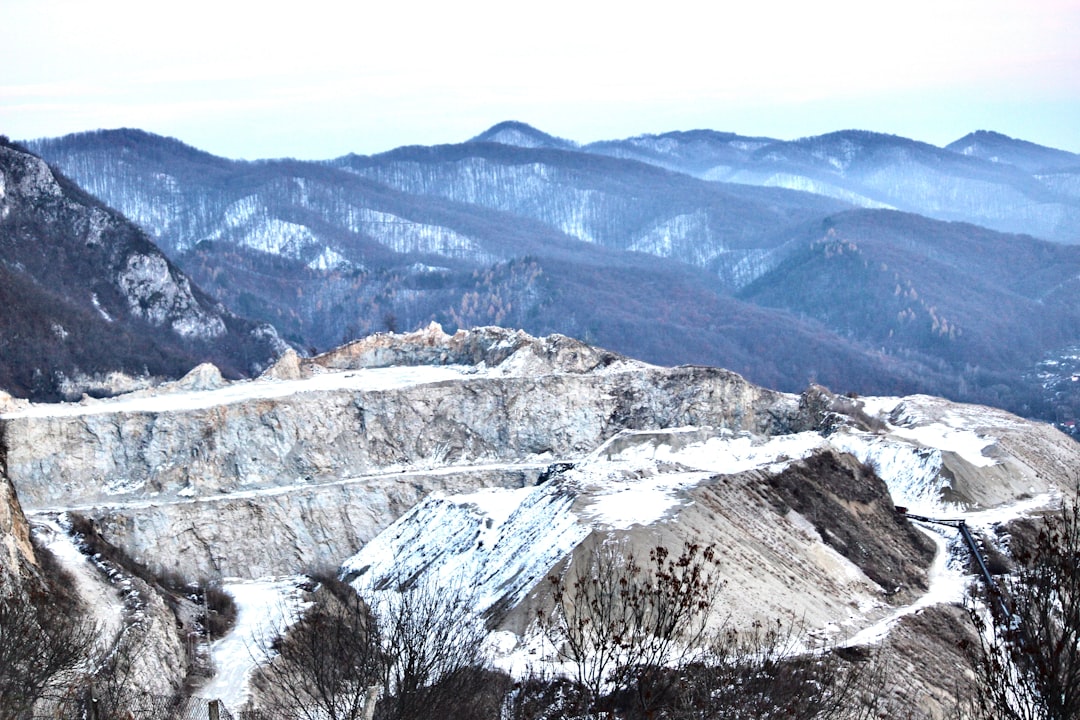
A processing facility near Brașov, operated by state-owned <b>Nuclearelectrica in the locality of Feldioara, is set to become a strategic node in the West's effort to break China's stranglehold on rare earth supply chains</b> — with Elon Musk's SpaceX named as one of the final beneficiaries of materials produced there, according to Romania's Minister of Energy.
The disclosure came from Bogdan Ivan, Romania's Minister of Energy, who confirmed in remarks reported by ProTV that rare earth minerals extracted in Greenland by the American company Critical Metals are destined to be processed at the Feldioara plant. Ivan stated explicitly: "Beneficiarii finali ai materiilor produse în România vor fi companiile deținute de Elon Musk, inclusiv cea care produce astăzi sateliți, SpaceX" — "The final beneficiaries of materials produced in Romania will be companies owned by Elon Musk, including the one that today produces satellites, SpaceX."
The facility near Brașov, Romania's third-largest city and an established industrial centre in the Carpathian arc, has until now operated with little public profile. Its emergence as a critical link in a transatlantic supply chain spanning the Arctic, Central Europe, and American aerospace is a development of considerable geopolitical weight — one that places Romania squarely inside the race to secure the materials underpinning the next generation of military hardware, satellite networks, and green-energy technology.
<h2>Why Romania, and Why Now</h2>
The timing is not coincidental. In 2025, the European Commission designated three Romanian projects — in Gorj, Hunedoara, and Bihor counties — as strategic under the EU's Critical Raw Materials Act. Those designations reflected Brussels' broader drive to source at least 10 percent of its critical minerals domestically and reduce imports from any single non-EU country to below 65 percent by 2030. The Feldioara arrangement extends that logic: even if the ore originates outside the EU, European processing capacity itself becomes a strategic asset.
The backdrop is the Draghi competitiveness report, presented to the European Commission in September 2024, which identified critical raw materials as one of three existential vulnerabilities for the EU economy alongside energy dependence and digital technology gaps. Mario Draghi warned explicitly that Europe risked falling into permanent industrial decline unless it built domestic processing infrastructure for the minerals that power defence electronics, electric vehicles, and communications satellites. Romania, with its existing nuclear industry expertise through Nuclearelectrica — the operator of the Cernavodă nuclear plant — offers processing know-how that few other EU member states can match at competitive cost.
<h2>The Rare Earth Calculus</h2>
Rare earth elements — the 17 chemical elements that include neodymium, dysprosium, and lanthanum — are not rare in geological terms but are extraordinarily difficult to extract and refine without generating toxic by-products. China currently controls roughly 85 to 90 percent of global rare earth processing capacity, a leverage point that Western defence planners have spent the better part of a decade trying to reduce. Greenland's geological deposits are among the most significant outside Chinese territory, which is precisely why Greenland has become a focal point of American strategic interest under both Democratic and Republican administrations.
The SpaceX connection adds a further dimension. Satellite production — the core business of SpaceX's Starlink programme — is extraordinarily rare-earth-intensive. Permanent magnets in satellite attitude-control systems, the electronics in phased-array antennas, and the motors in deployment mechanisms all require refined rare earth compounds. A secure, EU-based processing route for those materials would reduce SpaceX's — and by extension, American military communications infrastructure's — exposure to Chinese supply disruptions.
<h2>Romania's Industrial Gamble</h2>
For Romania, the arrangement represents both an opportunity and a test. The country joined the EU in 2007 after a transition from communism that left its industrial base partially hollowed out; entire sectors that had been artificially maintained under Nicolae Ceaușescu's autarchic industrialisation were dismantled in the 1990s. The post-communist generation of Romanian policymakers has long sought foreign direct investment as the primary route to reindustrialisation, but strategic sectors — energy, defence supply chains, critical materials — have remained contested.
Whether the Feldioara facility can scale to meet the ambitions implied by Minister Ivan's remarks remains to be established. No investment figures or operational timelines have been confirmed publicly. Sources in Bucharest familiar with the energy ministry's thinking told this correspondent that the arrangement is still in an early commercial phase, with due diligence and permitting processes ongoing.
What is already clear is that Romania's location on the EU's eastern frontier — long framed primarily as a security liability requiring NATO reassurance — is being reframed in Bucharest as a logistical and industrial asset. In Romania, as across Eastern Europe, the transition is not over — it's ongoing. The Greenland connection suggests that, for the first time in decades, Romania's industrial geography may be working in its favour.