
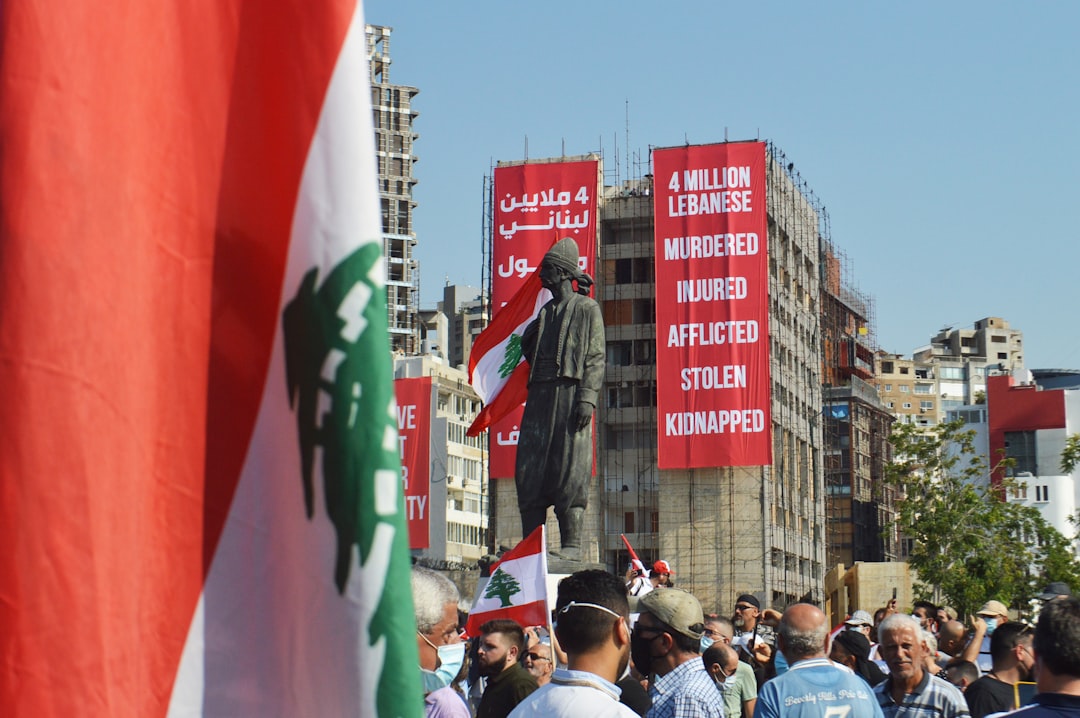
Beirut — Lebanon's newly formed government has triggered a wave of public anger after raising fuel prices, with citizens directing their frustration not only at the policy itself but at the deeper inequity it exposes: that the burden of a catastrophically mismanaged state continues to fall on those least responsible for its failures.
"They're passing the bill of this failed state onto the ones of us who refused to flee this sinking ship," wrote one Lebanese dual citizen on social media this week, in a post that rapidly circulated among diaspora communities and residents alike. "Tax the rich thieves out of existence. Seize assets. Don't push the burden of the failed and bloated public sector on me. I don't get anything from it."
The anger is not irrational. In this region, today's headline is yesterday's history repeating — and Lebanon's economic collapse did not begin yesterday. It began with decades of a political system designed to extract rather than serve, culminating in the financial implosion of October 2019 that wiped out the savings of ordinary depositors while the country's banking elite moved billions offshore in the months prior.
<h2>The IMF Benchmark Gap</h2>
The fuel price increase — implemented through the removal of remaining energy subsidies — sits at the intersection of two competing realities. On one hand, the International Monetary Fund has long conditioned any formal assistance programme for Lebanon on precisely this kind of subsidy rationalisation. Blanket subsidies, the Fund's technical teams have argued in successive Article IV consultations, disproportionately benefit wealthier households with vehicles and generators and represent a fiscal drain the state cannot sustain.
On the other hand, the IMF's roadmap for Lebanon has always included a second, equally essential pillar: a comprehensive restructuring of the banking sector, in which shareholders and large depositors absorb losses before ordinary citizens do. That pillar has not been implemented. The country's commercial banks — politically connected institutions whose board members overlap significantly with the ruling class — have successfully resisted loss recognition for more than five years, leaving the restructuring framework effectively frozen.
A Lebanese finance expert familiar with the IMF negotiations, speaking on condition of anonymity, described the sequencing failure as the central issue. "The government is applying the parts of the reform agenda that are easiest politically — cutting subsidies that affect the poor — while deferring indefinitely the parts that would require confronting the banking oligarchy," the expert said. "That is not reform. That is extraction dressed up as fiscal adjustment."
<h2>The Aoun Question</h2>
President Joseph Aoun, inaugurated in January 2026 after a presidential vacancy of more than two years, came to office on a platform that explicitly promised a break from the clientelist logic of the taifiyya — the sectarian apportionment system that has governed Lebanese politics since the 1943 National Pact and hardened into its current form under the 1989 Taif Agreement. Prime Minister Nawaf Salam's cabinet, formed in late January, was presented as a government of professionals rather than political appointees, drawing cautious praise from international observers and Lebanese civil society figures who remember the uprising of October 2019.
The fuel price decision has complicated that narrative. Critics note that raising prices on petrol and diesel — commodities on which working-class and middle-class Lebanese depend, given the near-total collapse of public transportation and the state electricity grid — without simultaneously moving against accumulated wealth in the banking system or the vast informal fortunes of politically connected business figures represents a continuation, not a rupture, of Lebanon's fiscal logic.
The anger on social media was pointed in its specificity. One post noted that a captain in the security forces maintains a state-salaried driver and a permanent residential guard — emblems of a bloated public security apparatus that consumes resources while delivering minimal public benefit. Another referenced commercial developments in Khalde, a coastal suburb south of Beirut, alleged to have been constructed through proceeds of customs corruption. "Seize his assets," the poster wrote. "Don't pass the burden onto me."
<h2>The Banking Sector Overhang</h2>
The shadow looming over all of this is the unresolved question of Lebanon's banking sector losses. The Banque du Liban — the central bank — accumulated what the IMF has estimated at losses exceeding $70 billion through a Ponzi-like financial engineering scheme known domestically as al-handaseh al-maliyya (financial engineering), in which commercial banks deposited funds at the central bank in exchange for above-market returns, funding a cycle that required ever-larger inflows to sustain.
When the scheme collapsed in late 2019, depositors lost access to their savings. Ordinary Lebanese — teachers, engineers, shop owners, emigrant workers who had sent remittances home for decades — watched accounts denominated in dollars be converted at artificial exchange rates worth a fraction of their original value. The banks, however, have largely avoided formal write-downs. Legislation to distribute losses across shareholders, large depositors, and the state has stalled repeatedly in parliament, where the banking sector wields significant influence through direct and proxy representation.
The IMF's staff-level agreement with Lebanon, reached in 2022 and still not converted into a formal programme four years later, explicitly required banking sector restructuring as a prior action. That condition remains unmet. Without it, the Fund has withheld approximately $3 billion in programme financing that Lebanon urgently needs to stabilize its public finances.
<h2>Reform or Managed Extraction?</h2>
The government of Nawaf Salam has limited time before its initial goodwill with the public — and with international creditors — erodes entirely. Economists who have tracked Lebanon's political economy note that the path forward requires moving on multiple fronts simultaneously: reforming the energy sector's cost structure, yes, but equally pursuing a credible capital gains or wealth levy on fortunes accumulated during and after the financial collapse, alongside a genuine banking resolution law.
The citizen voices now circulating on Lebanese social media are not simply venting. They reflect a precise political understanding, shaped by six years of watching the powerful absorb no consequences while ordinary families lost everything. As one post put it, with the bluntness that has characterised Lebanese public discourse since the thawra — the uprising — of October 2019: "I shouldn't be taxed if I get no social benefits from the state."
That sentence encapsulates the legitimacy crisis at the heart of Lebanon's reform dilemma. A government that cannot deliver electricity, safe water, functioning hospitals, or a credible banking system cannot credibly demand sacrifice from the citizens it has failed. The speaker of parliament, Nabih Berri — in his third decade in office, a symbol of the very zu'ama (feudal political chieftains) system the new government was elected to displace — retains significant leverage over the legislative calendar. Banking reform laws that threaten connected interests will face the same parliamentary obstruction that has buried them before.
The Aoun-Salam government has inherited a debt — moral and fiscal — accumulated across generations of elite misrule. How it chooses to repay it, and to whom it passes the immediate bill, will be the defining question of its tenure. So far, the fuel price hike suggests that the bill, as always in Lebanon, is going in the same direction it always has: downward.