
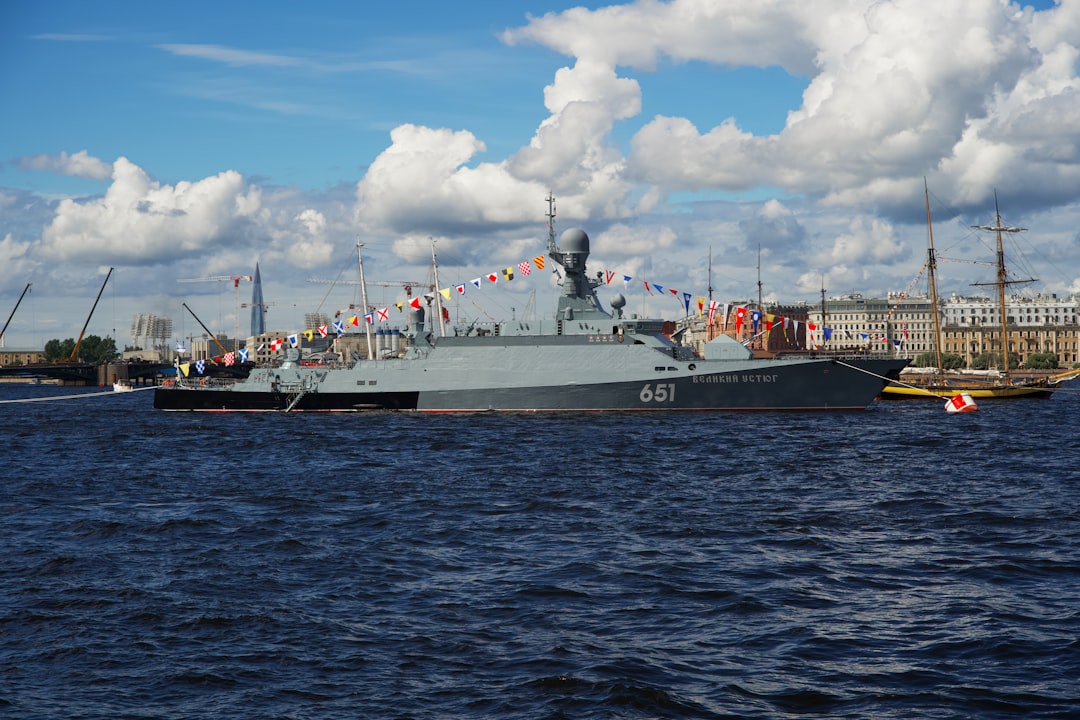
Nikolai Patrushev, the Kremlin aide tasked with overseeing Russia's shipping interests and one of President Vladimir Putin's closest advisers, has warned that Russia's navy stands ready to deploy against what he characterized as Western acts of "piracy" targeting Russian merchant and oil-carrying vessels.
"We believe that, as at all times, the best guarantor of navigation safety is the navy," Patrushev said in remarks reported by Al Jazeera on Wednesday. "If we do not resist decisively, the English, the French, and even the Balts will soon be so bold." He added that "substantial forces must be permanently deployed" capable of "cooling the ardour of Western pirates."
The language is striking in its directness. Patrushev — a former director of the Federal Security Service, the FSB, and one of the most enduring figures in Moscow's national security establishment — is not given to empty rhetoric. When he speaks in terms this explicit, it signals deliberate intent from the top of the Russian state.
The immediate context: shadow fleet enforcement
The proximate cause is a series of Western enforcement actions against Russia's so-called "shadow fleet" — the network of aging, often legally murky tankers that have allowed Moscow to continue exporting oil despite Western sanctions imposed following the 2022 invasion of Ukraine. In January alone, United States authorities seized the Russian-flagged Marinera tanker; French vessels intercepted the Grinch tanker, later releasing it after its owner paid a multimillion-euro fine; and France had previously detained the Boracay vessel in September 2025, with its Chinese captain now facing trial.
For Moscow, these enforcement actions represent a direct assault on the economic infrastructure sustaining the war effort. Russian oil and fertilizer exports are the primary revenue stream keeping the wartime economy solvent.
The Kaliningrad signal
Perhaps the most consequential element in Patrushev's statement was his explicit reference to Kaliningrad, Russia's strategically vital Baltic Sea exclave, which is geographically separated from the Russian mainland and surrounded by NATO territory. Patrushev stated that if a "peaceful resolution" to any blockade fails, it "will be broken and eliminated by the navy."
This is not a casual reference. In Russia, as in much of the former Soviet space, understanding requires reading between the lines. The Kaliningrad reference invokes a scenario that would constitute a direct military confrontation with NATO members — Lithuania, Poland, and the Baltic states among them — along one of the alliance's most sensitive corridors. In the post-Soviet Russian strategic framework, Kaliningrad has always functioned as both an asset — home to the Baltic Fleet — and a vulnerability. Any suggestion that its supply lines could be severed triggers maximalist responses in Kremlin security thinking.
The shadow fleet's resilience
Western governments have progressively tightened enforcement of the sanctions architecture designed to cap Russian oil revenues. The United Kingdom, the European Union, and the United States have separately sanctioned hundreds of vessels associated with the shadow fleet. Insurance companies in Western jurisdictions have been pressured to withdraw coverage from non-compliant ships.
The fleet has nonetheless demonstrated resilience. Independent shipping analysts estimate that Russia continued to export approximately 3 million barrels of crude per day through 2025, largely circumventing the G7 price cap mechanism through the use of non-Western intermediaries and flags of convenience.
NATO implications
For the NATO Baltic states, Patrushev's statement arrives at a moment of acute anxiety about alliance credibility. The prospect of Russian naval vessels actively interdicting Western enforcement operations — whether in the Baltic Sea, the North Sea, or beyond — would constitute a qualitative escalation beyond anything seen since the Cold War.
Independent Russian analysts, speaking on background to international outlets, have noted that such a deployment would face serious practical obstacles. The Russian Baltic Fleet has been degraded by losses in the Black Sea theatre and by deferred maintenance. Nonetheless, the statement serves a clear deterrent purpose — and may also be aimed at a domestic audience increasingly attentive to whether Russia can sustain its economic position under sustained Western pressure.
This story connects directly to a parallel development: Ukrainian intelligence agencies have separately warned of Russian preparations for a mass naval drone offensive in the Black Sea, suggesting a broader pattern of Russian naval assertiveness across multiple theatres simultaneously.