
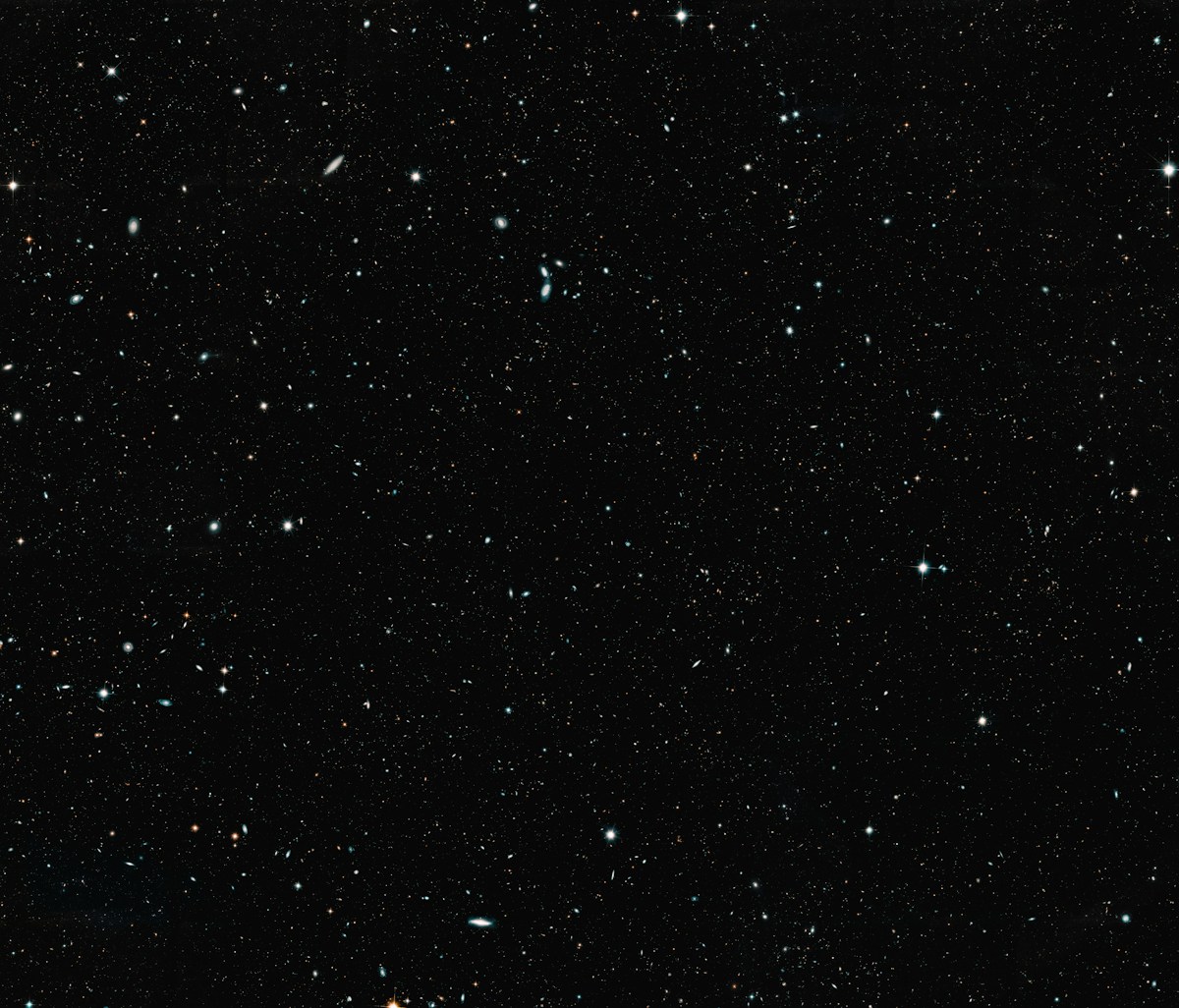
They did not find this galaxy by looking at it. They found it by looking for its star clusters. That methodological pivot — searching for tight groupings of globular clusters as a proxy for hidden, ultra-faint galaxies — is the real breakthrough buried inside a remarkable new Hubble Space Telescope discovery announced this week.
The galaxy is called CDG-2 (Candidate Dark Galaxy-2), and it sits 300 million light-years from Earth in the Perseus galaxy cluster. Its total luminosity is equivalent to roughly one million Suns — about as bright as a moderate globular cluster in our own Milky Way. For context, the Milky Way contains hundreds of billions of stars. CDG-2 is essentially invisible against the background glow of the universe. And yet an estimated 99 percent of its total mass is dark matter.
Detection by Proxy: The Globular Cluster Method
The standard approach to finding galaxies is to look for the diffuse light of their stars. That method fails catastrophically for objects like CDG-2, whose stellar population is too sparse to register in most surveys. Astronomer David Li and colleagues took a different route: they mapped the spatial distribution of globular clusters — dense, gravitationally bound balls of stars that are far brighter, per unit mass, than the surrounding galaxy — and used statistical clustering algorithms to identify concentrations that might indicate a hidden host galaxy.
"This is the first galaxy detected solely through its globular cluster population," the ESA Hubble team confirmed. The technique identified 10 previously confirmed low-surface-brightness galaxies and flagged two new candidates, of which CDG-2 is the more dramatic.
CDG-2 hosts only four globular clusters, compared to more than 150 in the Milky Way. But those four clusters were enough: their spatial proximity exceeded what random chance would predict, flagging an underlying mass concentration. What anchors that mass — and what makes up the remaining 84 percent of the galaxy's visible content — remains under investigation.

Multi-Observatory Confirmation
Hubble provided the high-resolution imaging that resolved the individual globular clusters. But confirmation required two more instruments. ESA's Euclid space observatory, designed specifically to probe dark matter and dark energy on cosmological scales, detected the extremely faint diffuse light of CDG-2 itself — the ghostly stellar haze surrounding those four clusters. And Subaru Telescope in Hawaii provided complementary ground-based data.
"The Euclid data clearly confirm the presence of the extremely faint, diffuse light of CDG-2, revealing the galaxy behind the globular clusters for the first time," said Francine Marleau, a co-investigator on the study.
That multi-instrument cross-validation is significant. Each observatory answered a different question: Hubble resolved what the clusters are; Euclid confirmed there is a galaxy at all; Subaru provided positional and photometric context. Together they ruled out the possibility that the cluster alignment was coincidental.
Why CDG-2 Is So Dark
The leading explanation is gravitational tidal stripping. The Perseus cluster is one of the most massive galaxy clusters in the local universe — a chaotic gravitational environment where galaxies regularly pass close enough to each other to have their outer gas and stars torn away. CDG-2 almost certainly lost the vast majority of its normal baryonic matter — hydrogen gas and loosely bound stars — through repeated tidal interactions with Perseus's larger members.
What survived is the dense, gravitationally bound core: the globular clusters, and the dark matter halo. Dark matter does not interact electromagnetically, which means it cannot radiate energy and cannot be easily stripped by tidal forces. It holds on. The globular clusters, similarly, are gravitationally dense enough to resist disruption. The diffuse stellar disk, the gas reservoir, the loosely bound outer stars — all of that is gone, scattered into the intracluster medium.
A Replicable Technique With Broad Implications
The methodological implications extend well beyond CDG-2. The globular-cluster-tracing approach is replicable at scale. Euclid, which surveyed billions of galaxies during its sky scan, has the depth and resolution to apply this technique across thousands of galaxy clusters simultaneously. The Vera C. Rubin Observatory in Chile, which begins its Legacy Survey of Space and Time in 2025, is similarly positioned to detect faint globular cluster populations across the southern sky.
"If we can find galaxies that are essentially invisible by cataloguing their star clusters," Li's team argued, "then the universe's population of dark-matter-dominated objects may be far larger than current surveys suggest."
The current census of ultra-diffuse galaxies and dark galaxy candidates is almost certainly incomplete — limited not by their rarity but by our detection methods. With Euclid and Rubin now online, that census is about to expand dramatically.
In space exploration, as across technological frontiers, engineering constraints meet human ambition — and occasionally, we achieve the impossible. In this case, the constraint was luminosity itself: a galaxy too dim to see. The solution was not a more powerful telescope but a cleverer question — and the answer may reshape how astronomers map the dark-matter-dominated universe.