
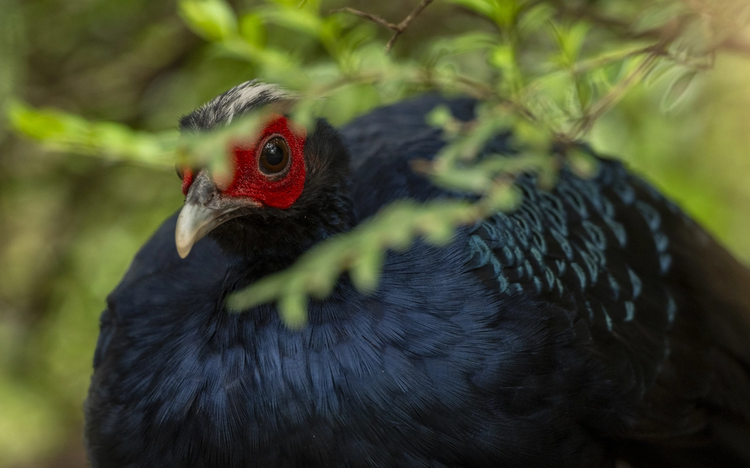
Vietnam welcomed home twenty Edwards's pheasants from Germany this week, marking a critical step in efforts to save a species that survives only in captivity after disappearing from its native forests.
The birds, transported in specially designed crates with expert supervision, arrived as part of a landmark international conservation collaboration between the Berlin Zoological Garden, Prague Zoo, the World Pheasant Association, and Vietnamese conservation organizations.
Edwards's pheasant, endemic to Vietnam's central forests, is classified as critically endangered by the International Union for Conservation of Nature. The last confirmed wild sighting occurred in 2000, making the species functionally extinct in nature despite surviving in European zoos descended from birds taken during the colonial era.
"Each bird was chosen based on genetic diversity, health condition, and behavioral characteristics," according to Tuoi Tre News, which reported the repatriation.
The pheasants will undergo adaptation and quarantine at Phong Dien Nature Reserve in Hue City and Dong Chau–Khe Nuoc Trong Nature Reserve in Quang Tri Province rather than immediate release into the wild. Conservation officials plan to help the birds adjust to local climate conditions, form breeding pairs, and establish a bred-in-Vietnam generation before considering reintroduction.
The successful repatriation demonstrates Vietnam's evolving environmental priorities. The Communist Party leadership, while focused primarily on rapid economic development and manufacturing growth, has increasingly acknowledged biodiversity conservation as part of the country's international image and sustainable development goals.
Small numbers of Edwards's pheasants were taken to Europe in the early 20th century during France's colonial administration of Indochina. Those captive populations became the species' lifeline as Vietnam's forests faced destruction during the American War and subsequent agricultural expansion.
The birds' disappearance from the wild reflects broader environmental challenges across Southeast Asia, where economic transformation has often come at the cost of forest ecosystems. Vietnam lost more than half its forest cover during the 20th century, though reforestation efforts have restored some areas in recent decades.
In Vietnam, as across pragmatic one-party states, economic opening proceeds carefully alongside political stability. The same system that welcomed $35 billion in foreign direct investment in 2025 for electronics manufacturing now presents itself as capable of international scientific collaboration for species preservation.
The pheasant repatriation required diplomatic coordination between Vietnamese government agencies, European zoological institutions, and international conservation groups—a model of cooperation that transcends the country's political isolation during earlier decades.
Conservation experts emphasize the program's long timeline. Establishing breeding populations, developing release protocols, and restoring suitable forest habitat will require years of sustained commitment and funding. Success depends on protecting remaining forest fragments from development pressures in provinces seeking manufacturing investment.
The return of Edwards's pheasants occurs as Vietnam carefully balances its environmental commitments with its emergence as a manufacturing alternative to China. The government promotes both factory construction in coastal provinces and conservation initiatives in upland areas, attempting to demonstrate compatibility between economic growth and environmental responsibility.
Whether the pheasants ultimately return to truly wild populations depends on factors beyond captive breeding—forest protection, local community engagement, and sustained political will in a country where development pressures remain intense.